1
I woke up at 5:13am the other day, and it’s such a creepy time, usually reserved for fever dreams or groggily heading to the airport. I had no idea what to do at this hour. I was too stupid to read or write, and staring at a screen before dawn felt unwholesome.
So I turned on a light. I was not afraid of the darkness so much as the solitude of the pre-dawn mind, that black-and-blue hour when memory scampers around, fetching scraps of regret. They say more people die just before dawn than any other time: car crashes, heart attacks, overdoses, stabbings, and the majority of suicides. Maybe it’s reassuring this hour has a name, which means others have felt its uneasiness too. They call it the hour of the wolf.
In his 1968 film of the same name, Ingmar Bergman describes this hour as "when sleep is deepest, when nightmares are most real. It is the hour when the sleepless are haunted by their deepest fears, when ghosts and demons are most powerful. But the hour of the wolf is also the hour when most children are born."
So it’s an hour both frightening and generative, which might explain why I opened my pristine little sketchbook for the first time, along with a tray of watercolors I hadn’t yet found the courage to use.
2
Teeth are the only things I can reliably draw or paint, probably because they allow for imperfect cubes and clunky cylinders. As the sky turned from black to grey, I painted a tooth, and I thought it was looking pretty good in the November gloom. I moved on to the gums, and I was happy with how they were coming along, an almost convincing blend of pink and red. Then I dipped my brush into the wrong tray and a black splotch dribbled onto the page.
As I frowned at this inky malformed crescent, I began to see a screaming face. Okay then, let’s give it some arms and legs. But I botched the angle and now the figure was on its knees—oh wait . . . it’s praying. Soon a whole situation began to emerge: a strange world of dark little creatures praying to an enormous tooth. They were praying because they wanted to save their friend, who was flailing in what had become an angry sea.
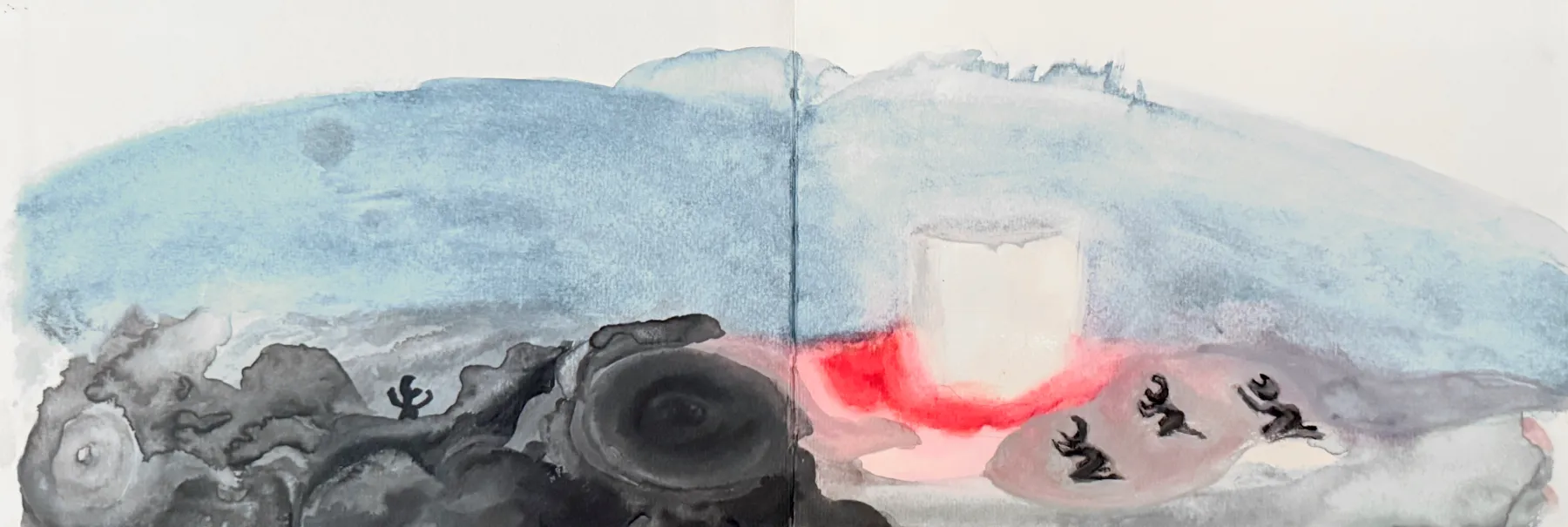
By now I should understand it’s good news whenever my intentions hit an obstacle, even if it never feels like it at the time, because this is the only way new possibilities emerge. Those airy zen axioms—non-practice is my practice and intentionless intention—finally become instructions with teeth.
And what about my fixation on teeth? Three theories: 1) I often dream about my teeth falling out or frantically picking them up off the street—but this produces a chicken-egg problem re: dreams inspiring the paintings or vice versa, so let's move on to 2) it’s my way of dealing with last year’s horrible gum surgery—but I think I’ve properly repressed this experience, which leads to the most likely answer: 3) it’s Francis Bacon’s fault.
3
There are many reasons Bacon’s paintings bother the mind. They are a crazed smear of flesh and velvety darkness, and his shrieking figures inhabit a zone that cannot be determined, a non-space defined by only a few ghostly lines that give his paintings the texture of a dream. They are portraits of the things that exist deep in the muck beyond the comfort of language. Which is a characteristic of all good painting. Maybe horror too. “Because the more violently, more strongly you feel about life,” said Bacon, “the more strongly you must be aware of death.”
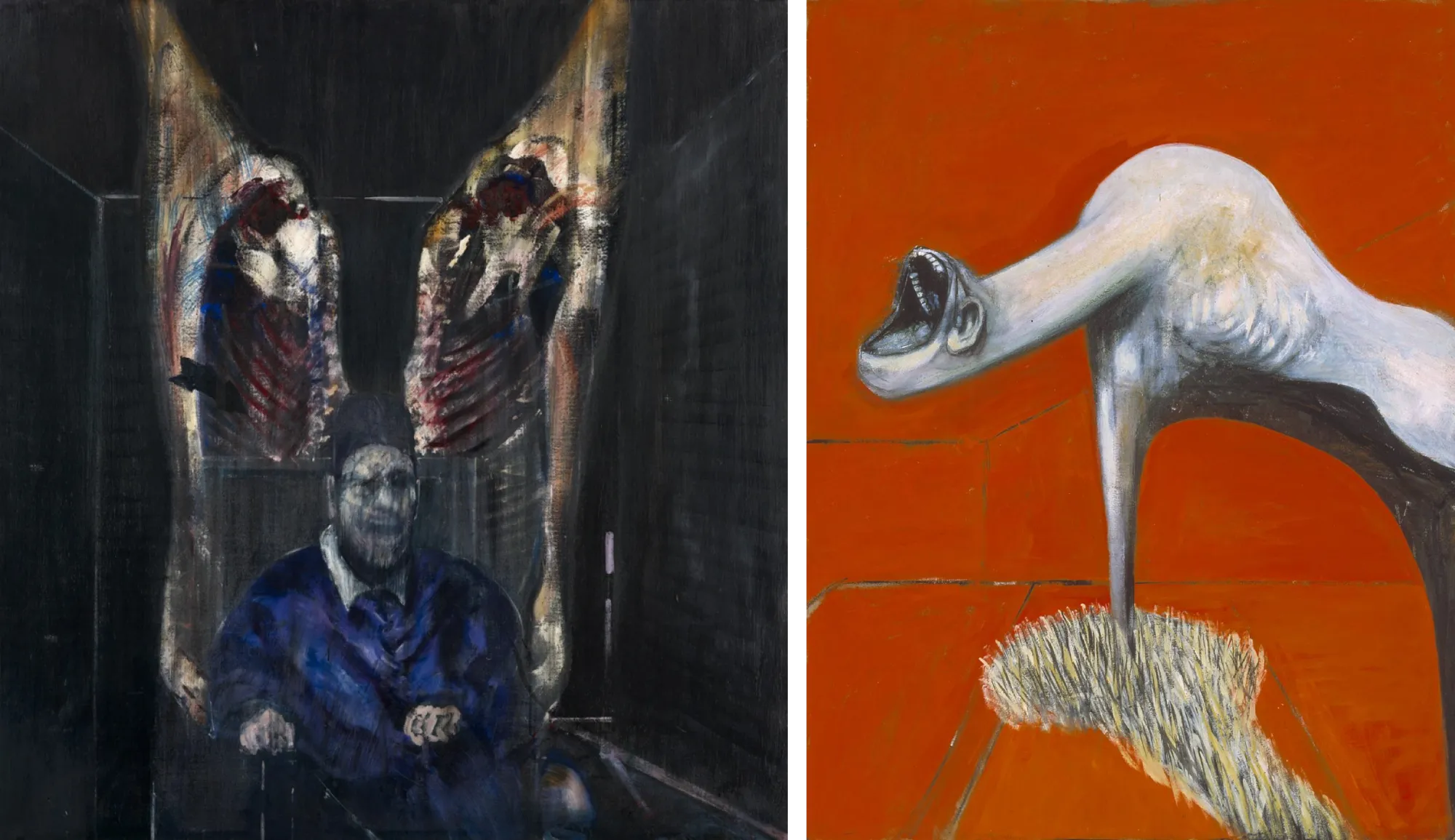
Bacon’s mouths haunt me the most. Especially his teeth. Without those perfectly articulated teeth, his paintings would evaporate into pointless abstraction. Instead, his realistic snarls provide a recognizable entry point to the surreal, that thin zone where, much like the hour of the wolf, daylight logic gives way to something more real and it becomes possible to believe ghosts inhabit a world like our own.
Bacon believed in “an area of the nervous system to which the texture of paint communicates more violently than anything else.” He’s right. And I’m beginning to understand that painting, both the viewing and making of it, is like finding pictures in the clouds. The ultimate Rorschach test.
4
When I remember my father, the tops of his Sambas are the first thing to appear in my mind’s eye, how they looked like cartoon tongues. Which means my core memory of my father is the early 1980s variant who wore flared jeans and ambitious sideburns. And so when I needed some good walking shoes for Taipei a few years ago, I bought a pair of Sambas. His were blue. Mine are black. But why are these sneakers such a foundational memory of my father? Why not his jacket in 1986 or his haircut in the 1990s or a funny thing he said in 2004?
I do not know enough about Shintoism to write about it intelligently, but I think kami is worth considering here, the notion that all things have their own interiority, some essence that claims our attention, which is why this tree or that rock and not that one and so on.
Can you intentionally etch a moment into memory or keep one out? I can't. Some other intention seems to be at work, which brings to mind Byung-Chul Han’s suggestion that memory is alive. “Memory is not an organ of simple restitution, by means of which one makes the past present again,” he writes. “It is a progressive, living process.”
5
A living process is how Bacon talks about painting, and he’s with us tonight, thanks to this video that Marty sent me a few months ago. Does Bacon believe in a god or spiritual dimension to the universe? It’s difficult to say. But when he talks with David Sylvester about painting, it sounds like Bacon believes a hand is involved that is not his own:
“Sometimes when I've been working, I've been so disgusted with the thing, I'm so sick of it that I just take the brush and put brush marks all over it, thinking, you know, fuck this thing. I can’t. It's not going to work at all. And then suddenly, out of this chaos, comes the possibility of making an image I hadn't thought of before. For instance, that painting in the Museum of Modern Art, I think I'd tried to do a gorilla in a cornfield. Then I tried to do a bird alighting, and then gradually all the marks I'd made suggested this other image. It was just a totally accidental image."
But why an accidental image?
"I’d never thought of doing an image like that ever in my life."
An image from the unconscious—is that an accidental image?
"Well, if you explain to me what the unconscious is, we'll say it's not an accident."
Is a dream image an accidental image?
"I couldn't tell you. You'd have to ask Freud."
He also offers two crucial reminders:
First: "Sometimes it's complete transformation . . . we've often talked about in these things, about the element of chance or accident or whatever you like to call it. But those things enter in only after you've started working."
Second: "If you are going to decide to be a painter, then I think you've got to decide that you are not going to care if you make a real fool of yourself."
6
Tonight’s broadcast includes several reverberated Bacon bits sprinkled across some songs that I’ve been playing during my morning painting sessions, many of which came from happy accidents and incidents. For example, the other day I had a lot of client work to do, so I spent an hour pondering what became of Richie Hawtin's post-Consumed career and discovered he made several songs for Prada’s 2021 Women’s Wear Collection (and if that doesn’t sound like a fever dream, I don’t know what does). But one of them is actually quite good. And I have no idea how Smooth entered my life, but it’s premium-grade dub techno (and name-your-price on Bandcamp). And a recent dispatch from Ian J. Battaglia encouraged me to revisit Ryuichi Sakamoto's async, which led me to the remixes, and the ever-reliable Tonearm introduced me to Recur via this excellent meditation on the metaphysics of the loop.
- Richie Hawtin - Sin Thetik (Ambient Version)
From Our Minds, 2021 • Bandcamp - Kareem - 11-1988
Zhark Recordings, 2025 • Boomkat - Smooth - Subtle Circuits Symphony
Contemporary Past • Cyan, 2017 • Bandcamp - Ryuichi Sakamoto - Solaris
async • Milan Records, 2017 - Ryuichi Sakamoto - Disintegration (Alva Noto Remix)
async Remodels • Milan Records, 2017 - Birds of Prey - Strange and Eternal
Vanishing Point • Mysteries of the Deep, 2019 • Bandcamp - Recur - Oscillate
A Strange Loop • Aumeta Records, 2025 • Bandcamp
Podcast • Download
In other news, this week I learned that Midnight Radio will be part of an exhibition about melancholia next year, which delights me to no end. As for the rest of 2026, stay tuned for two final Very Special Guest Episodes: Grant Aaron of the top-shelf Mysteries of the Deep imprint and Birds of Prey outfit (see above) will deliver some seasonal mist, then we’ll wind down the year with some Death Prom reverberations with assistance from Grace Wang.
Thank you for listening.

