1
But enough about robots and dying governments. Time to stop talking about the thing and start doing the thing. Like increasing my capacity for beauty and wonder, which can be a challenging muscle to exercise when the world feels like it’s sliding into a sinister dimension.
Ever since I’ve known C, she’s kept a grid of aspirational images taped to the wall to guide whatever she’s working on at the moment. Dozens of photographs, postcards, and clippings from magazines orbit her head. A mood board? I asked once. "No," she said. "An inspiration station." This phrase sticks with me because it sounds wonderfully ritualistic, like the stations of the cross.
Of course, I had to overengineer this idea and invest in fifty picture frames, first all black, then all white because I wanted to achieve a Platonic grid. Nail holes riddled my wall because I couldn't get the measurements right, so I tried some serendipity and wabi-sabi, but that was no good. I removed the glass from each frame because I couldn’t stand the shine. This was okay for a while, but the frames were eating valuable space that dwindled with each visit to a museum. C had it right all along: Tape is the way. Tape is fluid. Tape supports a changing mind.
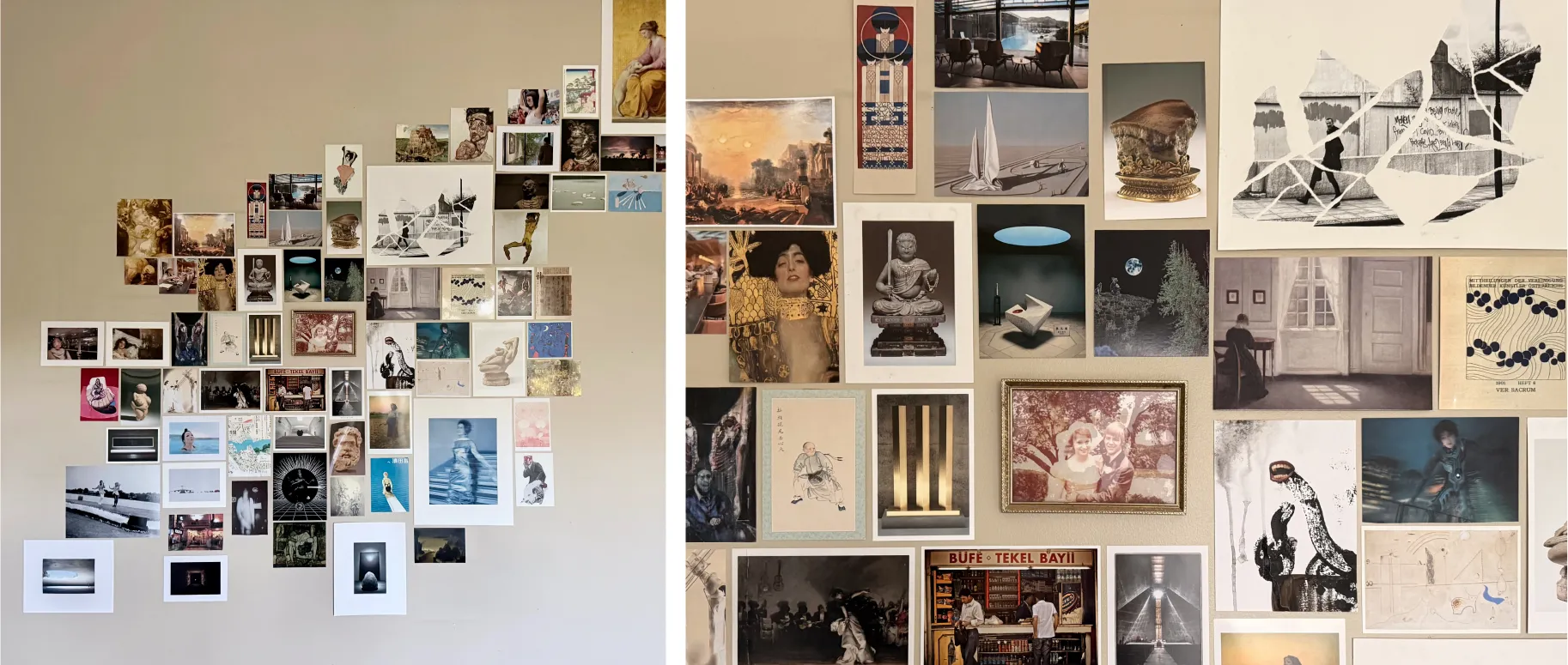
And the criteria for my inspiration station? Each picture is a story, and ideally it's been encountered in the flesh. Lately my nightly ritual is to pluck an image from the wall and spend ten minutes pondering it. It’s more fun than meditation, the way attending to color and shape conjures the muck of memory and sensation yet keeps me present-tense.
2

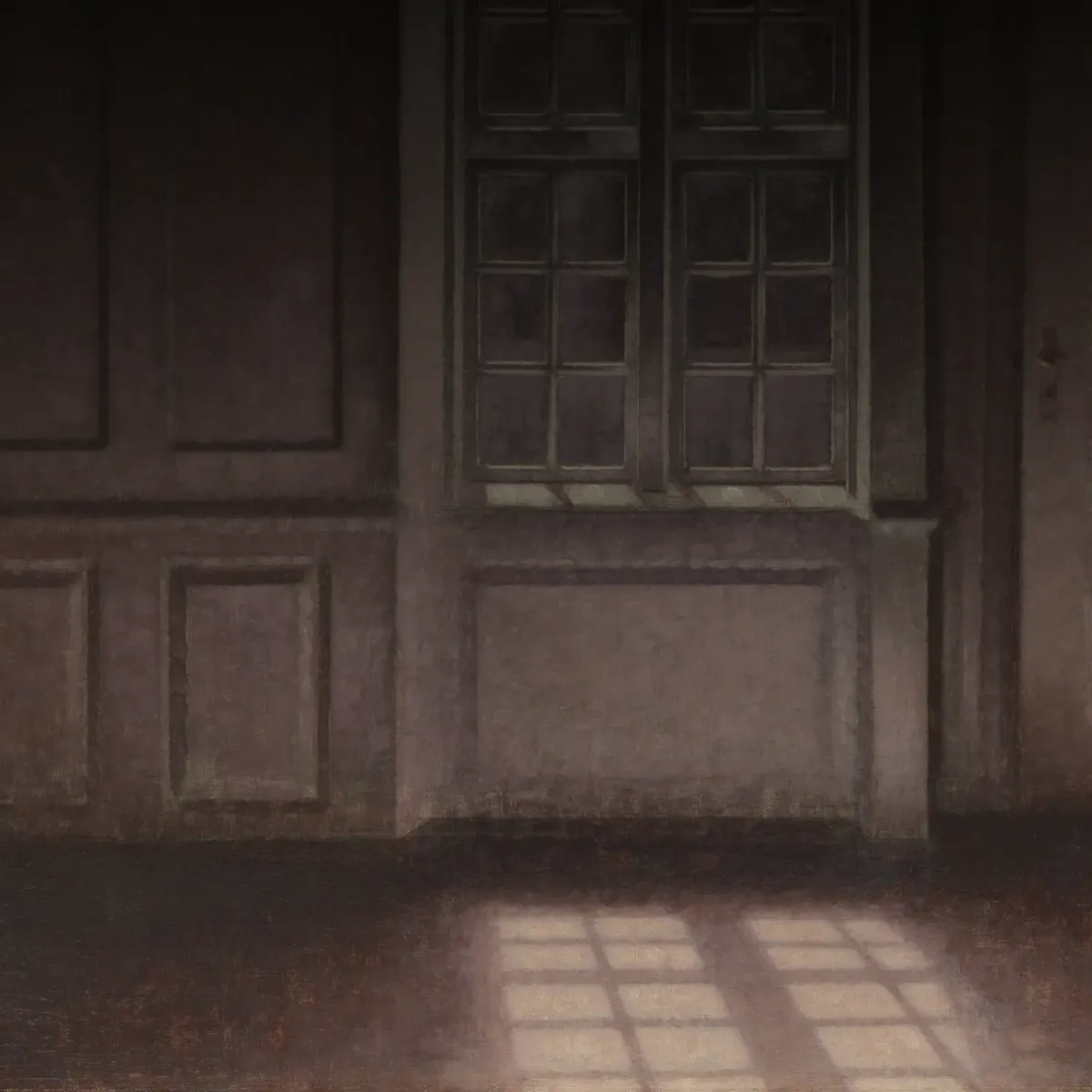
Vilhelm Hammershøi was a Danish painter who specialized in the muted and subdued. I first encountered his work last year at the National Gallery in Copenhagen, and I fell in love with his atmosphere. It looks like how memory feels, familiar yet beyond language. In the painting above, we do not know what the woman is doing at the table. There are no clues in the room, only space and light, anchored by the heft of a body clad in black, her head bent over something we cannot see.
At first, I thought she was writing a letter. Perhaps someone has died. Yet the longer I looked, I became certain she was praying. The zone between the pictures on either side of her head took on new weight, and the door loomed, suddenly portentous. Shutting herself in, or the world out. Hammershøi painted the interior of this apartment dozens of times at all hours of the day, yet no matter the hour, the light is strangely timeless, always the silent cool of moonlight or a winter sun. His paintings come to mind whenever I encounter the word hush, and I’d like to live in this light, so relaxed and tranquil—
3
—except this is not what being alive is like. Last week, C. and I were faced with tight schedules with no room for error, which we call Ray Liotta Days in honor of his busy day in Goodfellas that ends with helicopters and mayhem.
“I was dynamic,” he says. “I was moving packages left and right. But I had a very strict schedule. I had to be at my girlfriend Sandy's place by 1:30 to help her mix the stuff. I had to pick up my brother Michael at the hospital at 3:30. I had to see some guys from Pittsburgh at five o’clock. And I had to start the dinner. I was making ziti with meat gravy, and I'm roasting some peppers. Plus, I had to unload some guns that Jimmy didn't want.”
Our days were like this, except we had client presentations and a family trip to Philadelphia instead of veal cutlets and cocaine. So of course these plans were obliterated by a car wreck and trips to the hospital. (Everybody’s fine, but it’s time for my father-in-law to hang up his keys.)
Most contemplative traditions believe mental tension comes from living as a fragmented self. Governed by memory and fearful of the future, I often cannot meet the moment as it is. For instance, as I walked past the nurses’ station at the hospital, I caught some bad flashbacks from the last days of my parents, both of whom resisted going to the doctor until it was too late. Naturally, my impulse was to insist my father-in-law stay at the hospital for observation rather than fly to Philadelphia with us in ten hours.
But there he was, hospital gown flapped open, studying the x-rays of his skull that he’d requested because he’d been a doctor, a radiologist in fact. This situation had nothing to do with my past. And as for the future? The crushed deadlines became comic. Our commitments appeared absurd.
So we went to Philadelphia to celebrate C’s birthday, and there I finally experienced the cool mayhem of Duchamp’s "Nude Descending a Staircase" in person, its shattered figure a reminder that the future will break us into pieces if we’re not careful. I tried to explain its significance to my mother-in-law, who asked, “But where is this crazy person going?” This is already one of my favorite memories.
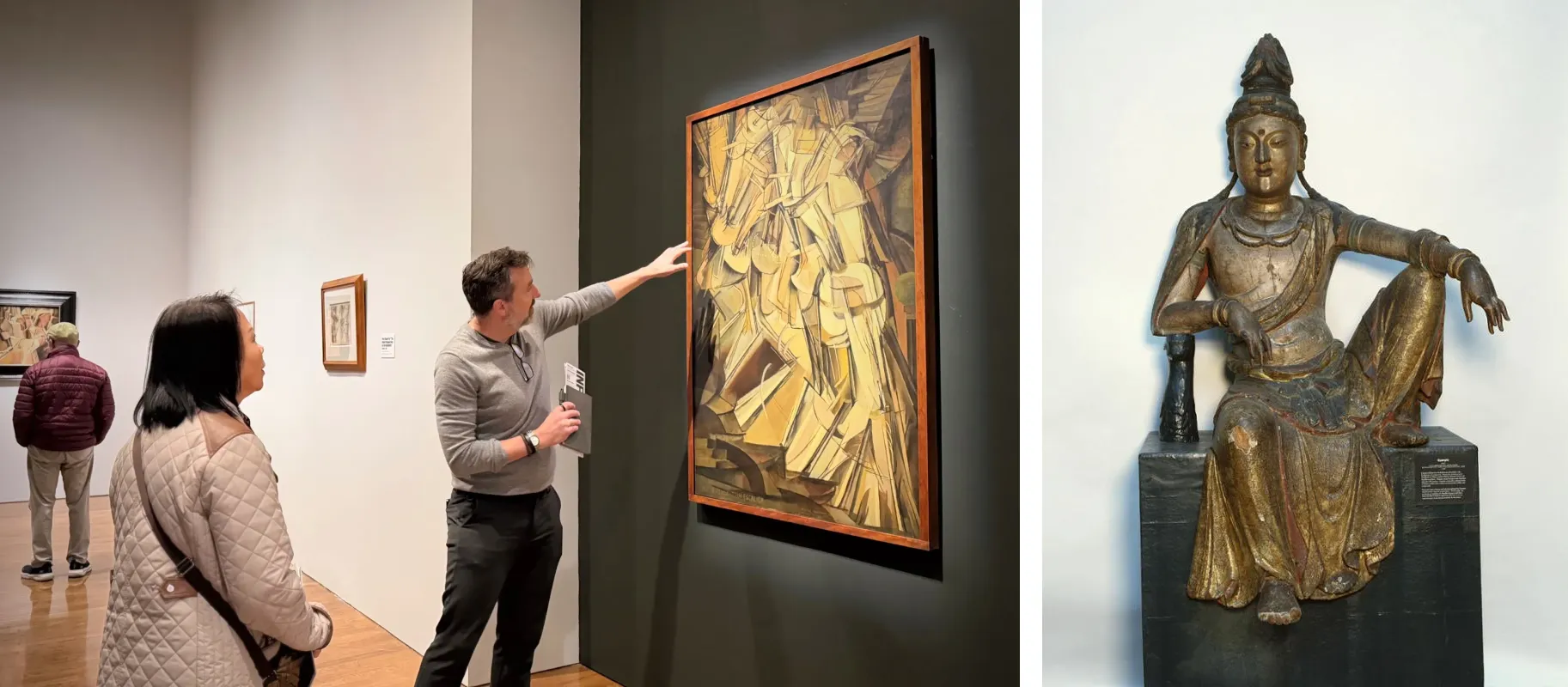
I also got to see several statues of Guanyin, bodhisattva of compassion or “perceiver of the world’s cries.” With one leg folded in lotus and the other dangling free, her posture is known as the "royal ease." Now there's a pose for the 21st century, one that projects "a calm, unforced dignity rather than rigid stiffness."
4
Tonight’s soundtrack is inspired by Hammershøi moonlight and the royal ease. These songs dance with uncertainty yet remain supercool, starting with Pole's scattered crackles that cohere around a sublime bassline, followed by a bleary night drive vocal and a series of low-end drones and drums that tilt toward the ritualistic.
After last month’s episode with Deb, I’m still keeping Mad Professor’s exploded Massive Attack tracks on loop, especially the demo reels. I love how they move in fits and starts, flirting with a groove before abruptly rewinding or stalling out in negative space. You can hear his fingerprints. This is controlled chaos.
Then there's a track I made with my friend Earl. We’d been passing a file around for a few weeks, adding and echoing and reverberating when the spirit moved us, and it was a delightfully generative, low-stakes process. It wasn’t until the second week that I understood why Earl was naming the files “je”—no, he wasn’t suddenly interested in French. These were our initials. So that’s the name of our thing.
We lost Juan Atkins today. In 1985, he drafted the urtext for Midnight Radio with "Night Drive Thru Babylon", but tonight we’ll spend some time with him in Berlin circa ’95, where he helped carve out the cavernous wonderland of dub techno. Two remixes of Starlight appear from the Deepchord and Basic Channel camps, and I was going to end with Atkins’s "Moon Beam" because it harmonizes with the title of this episode, but instead I chose a slice of perfection called “Walking on Water.” Because he did.
Thank you for listening.
- Pole - Modul
1 • Matador, 1998 • Bandcamp - Pieter Nooten & Michael Brook - Searching
Sleeps With the Fishes • 4AD, 1987 • Bandcamp - Civilistjävel! - Strinne Ett
Älvgång • Six of Swords, 2026 • Boomkat - BNNT & Radwan Ghazi Moumneh - The Sad
A Faithful Daughter • Ruptured, 2026 • Boomkat - Plastikman - Contain
Consumed • Minus, 1998 • Bandcamp - Holy Tongue - Bloom in D Minor
Basilikum • AD 93, 2026 • Bandcamp - Mad Professor v Massive Attack - Spying Glass Dub Demo
No Protection Dub Tapes • 1994 • Bandcamp - Je - 001
Ritual Fields, 2026 • Bandcamp - Model 500 - Starlight (Phase90 Mix)
Starlight • Echospace, 1995/2008 • Bandcamp - Model 500 - Starlight (Moritz Mix)
Starlight • Metroplex, 1995 • Boomkat - Juan Atkins - Walking on Water
Skynet • Tresor, 1998 • Bandcamp