1
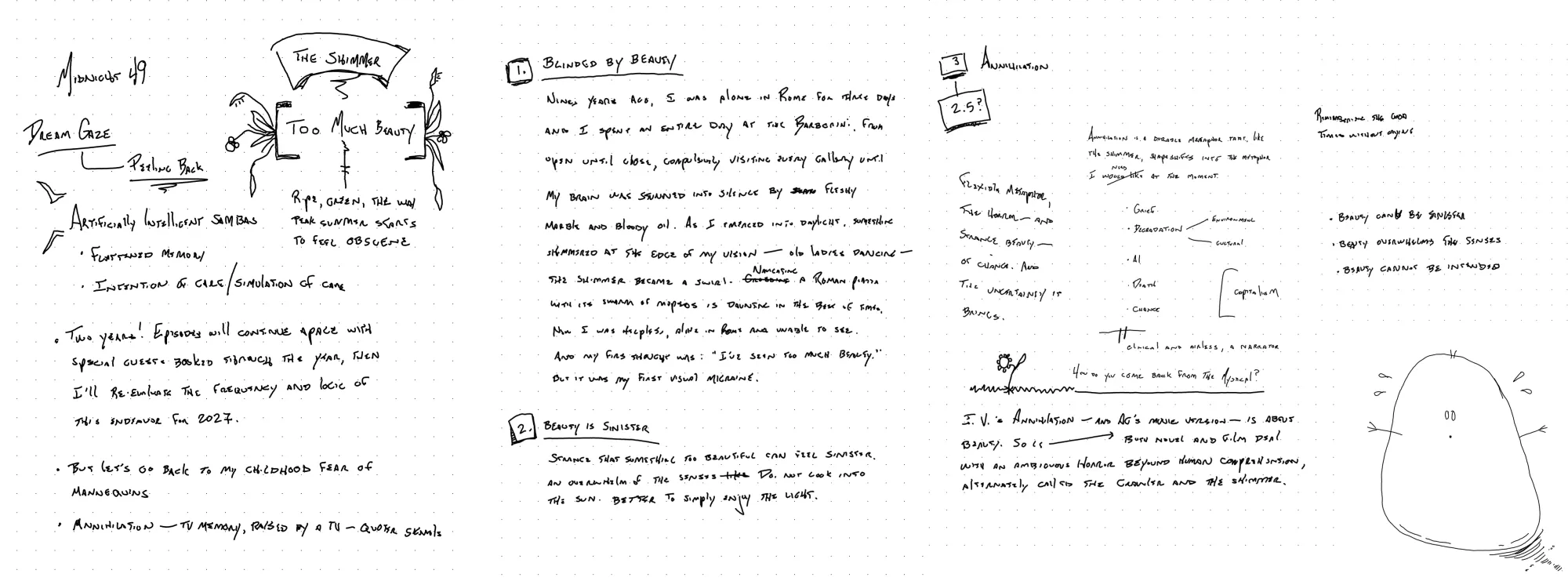
Nine years ago, I was unexpectedly alone in Rome so I spent the day at the Barberini, where I consumed so much Bernini and Caravaggio that my brain was stunned into silence by all that fleshy marble and bloody oil. When I reemerged into daylight, something shimmered at the edge of my vision, a glittery squiggle that had not been there before.
The shimmer became a swirl that shrouded my sight like when the horizon appears to boil, a mirage that Italian sailors called vecchie signore che balla: old ladies dancing. Navigating a motorcycle-infested Roman piazza is difficult under the best conditions, and now I was helpless, alone in a strange city and unable to see. I collapsed into a café chair and waited to find out if I would go blind. This was my first visual migraine, but my first thought was I've seen too much beauty today.
2
Strange that beauty can be sinister. A dare or a test. As if madness might come if one looks or lingers too long.
Jeff VanderMeer's Annihilation is a story about beauty. So is Alex Garland's film version. Both confront an ambiguous horror, alternately called the Crawler and the Shimmer, that exists beyond comprehension. As the narrator, a biologist, journeys toward its center, she encounters a landscape so plush and green it troubles the mind. Sort of like how summer starts to feel a little obscene. The world looks too bright and vivid, too ripe. Especially here in the Middle West, where we're currently melting beneath a heat dome.
"The beauty of it cannot be understood," says the biologist. "When you see beauty in desolation it changes something inside you. Desolation tries to colonize you."
I've been pondering this for weeks, how it feels right even if I don't understand it. Perhaps something is beautiful because it overwhelms the senses. And when the senses are flooded, a reckoning with our limits follows. Our mortality. Our insignificance. Desolation of the ego, perhaps.
"What occurs after revelation?" asks the biologist. The answer comes quick: "Either death or a slow and certain thawing. A returning to the physical world."
Do not look directly into the sun. Better to simply enjoy its light.
3
Last week, a dozen of us gathered to discuss Annihilation, how its horror is a limber metaphor that, like the creature at its center, shapeshifts into the meaning we need at the moment. The first time I read it, I interpreted it as a fable about grief. This was shortly after my father died. Now, ten years later, I think it's about the anxiety and beauty of change. And the uncertainty it brings.
Although Annihilation was published ten years before the mass-market arrival of artificial intelligence, C. thinks the shimmer evokes AI's uncanny mimicry, its sycophantic language and too-many-fingered hands. The biologist's attempt to categorize the horror she encounters certainly anticipates this direction:
It creates out of our ecosystems a new world, whose processes and aims are utterly alien—one that works through supreme acts of mirroring, and by remaining hidden in so many other ways, all without surrendering the foundations of its otherness as it becomes what it encounters.
Other friends suggested environmental degradation, panic, a poisonous media culture, and of course, the ravages of capitalism. But we all agreed there is a beauty to this horror, which VanderMeer emphasizes is pristine, stunning, and exquisite. Everything is flowering. The colors dazzle.
As I sat in a friend's living room while the daylight dwindled and voices I love lightly bickered, I felt a brief but undeniable sense of grace, a momentary hush. Beauty cannot be calculated or intended. It is always incidental. Unexpected.
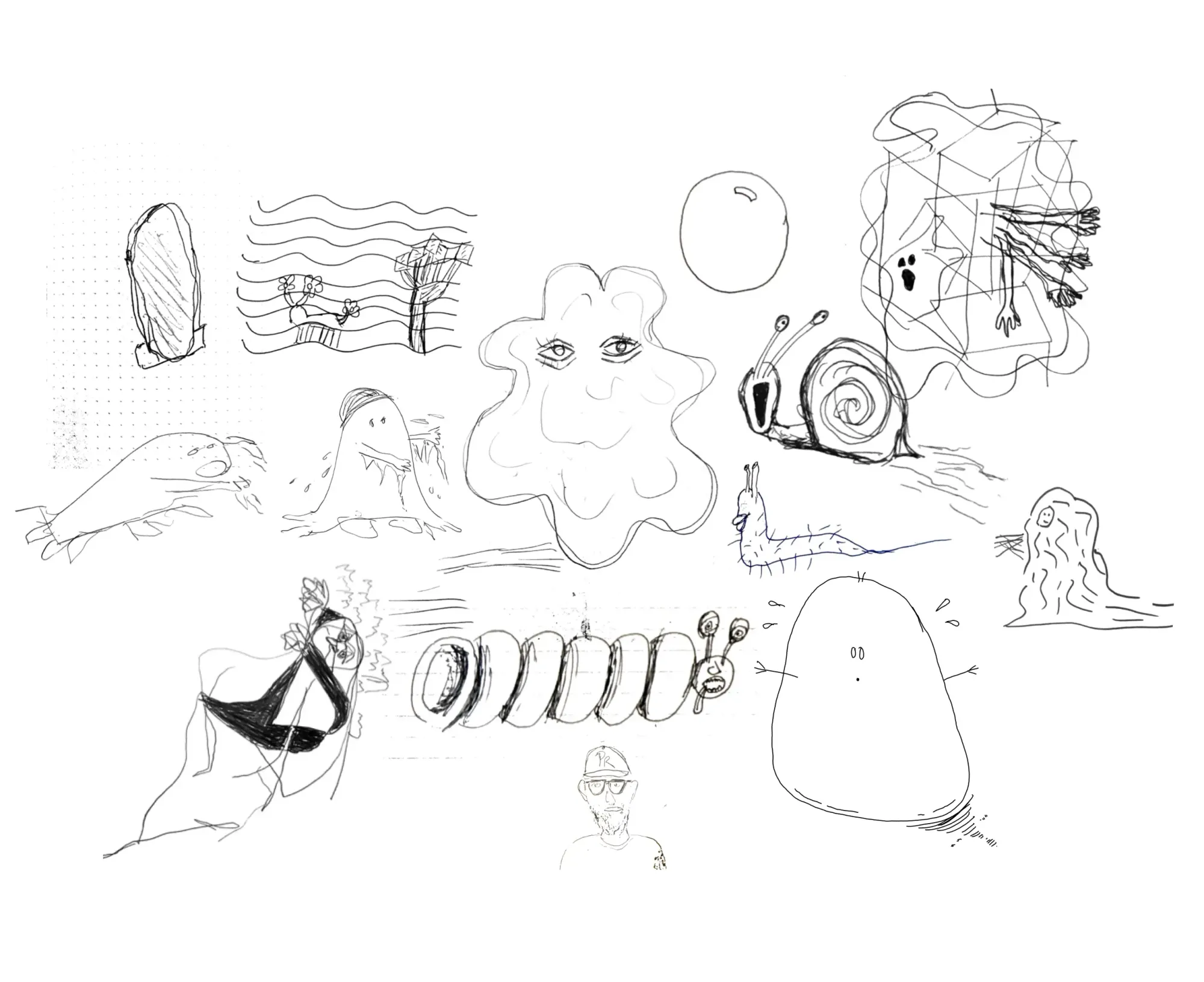
We ended the evening by drawing how we imagined the Crawler or Shimmer might look. Our drawings certainly weren't trying to be beautiful, but I think they are.
4
And so I've stitched together a soundtrack that follows tonight's rules of beauty:
- Beauty is almost sinister.
- Beauty overwhelms the senses.
- Beauty cannot be intended.
We begin with billowing vocals and cloudy guitars that gradually disintegrate until we're left with instrumentals, each peeling back layers of sound to uncover an endless thrum from Éliane Radigue, who sought to evoke the Tibetan Book of the Dead after she lost her son. I first heard this song an hour before dawn and I think it's what revelation must sound like. Then we come home to one of the most beautiful pieces of music I know: a glittery guitar from Windy & Carl that sounds like temptation itself.
- Mister Baby - Canyon City Blues
EP • 2023 • Bandcamp - Midwife - Angel
Prayer Hands • Antiquated Future, 2018 • Bandcamp - Sugar Plant - Impure
Trance Mellow • Pony Canyon, 1996 • Bandcamp - Hilary Woods - Faults
Night CRIÚ • Sacred Bones, 2018 • Bandcamp - Romance & Not Waving - Shepherd's Dream
Wings Of Desire • Ecstatic, 2024 • Bandcamp - Flying Saucer Attack - Instrumental Wish
Distance • VHF, 1994 • Bandcamp - Brian Eno - Dunwich Beach, Autumn 1960
Ambient 4: On Land • EG Records, 1982 - Éliane Radigue - Kyema (Excerpt)
Trilogie de la Mort • 1988 • Bandcamp - Windy & Carl - The Sun
We Will Always Be • Kranky, 2012 • Bandcamp
Download • Podcast
Tonight marks two years of Midnight Radio! Thank you for tuning in, and for the delightful notes and other forms of encouragement along the way. In these days of mind-numbing overload, attention is a gift I neither expect nor take for granted. Perhaps this is why Midnight Radio is the only deadline I've managed to honor. Episodes will continue to arrive on the 1st and 15th until the end of the year, at which point I'll reevaluate this endeavor.
In other news, I've made some significant upgrades to Spite if you're in the market for a dignified music player without any algorithms or bullshit. This heavyweight mix from Marty is an ideal thing to play on it.
This 49th episode is 49:49.