James A. Reeves

Public Works

After the End
Photo by Walter Wlodarczyk

After the End

“Memorial artworks are notoriously difficult to pull off. Yet Candy Chang and James A. Reeves, two New York artists who have created similar installations in the past, hit just the right tone with After the End, a participatory work in the Historic Chapel at Green-Wood Cemetery.”
THE NEW YORK TIMES

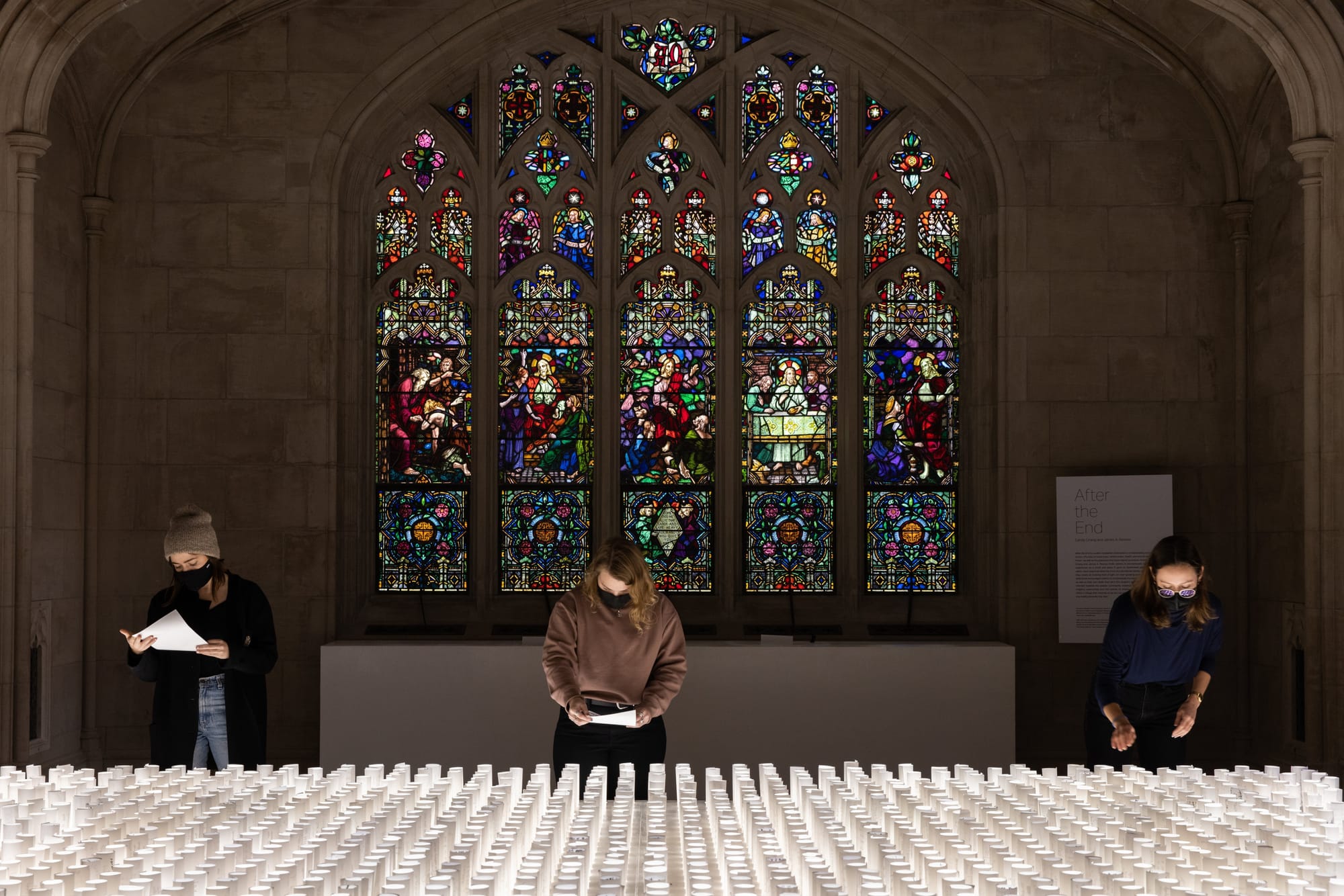
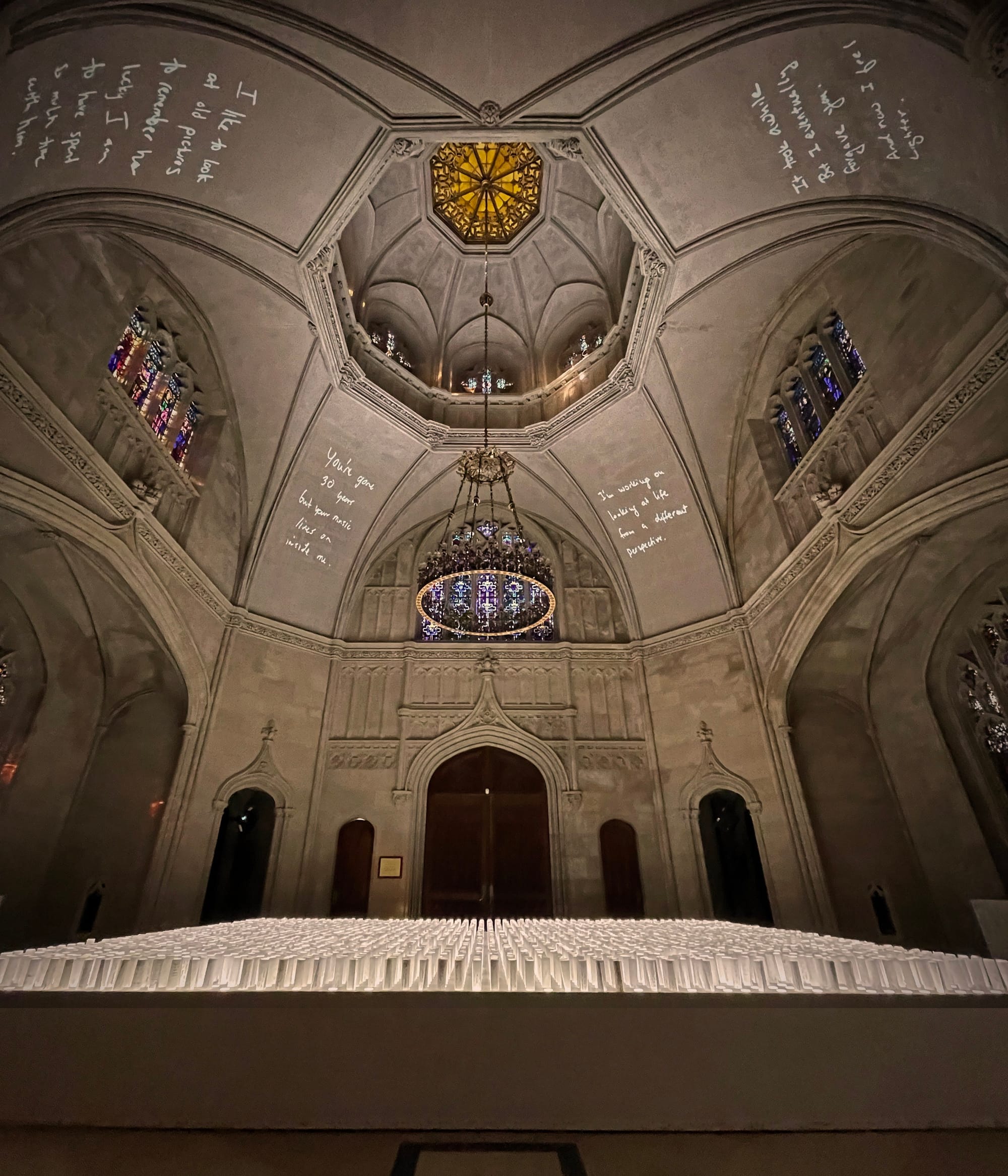
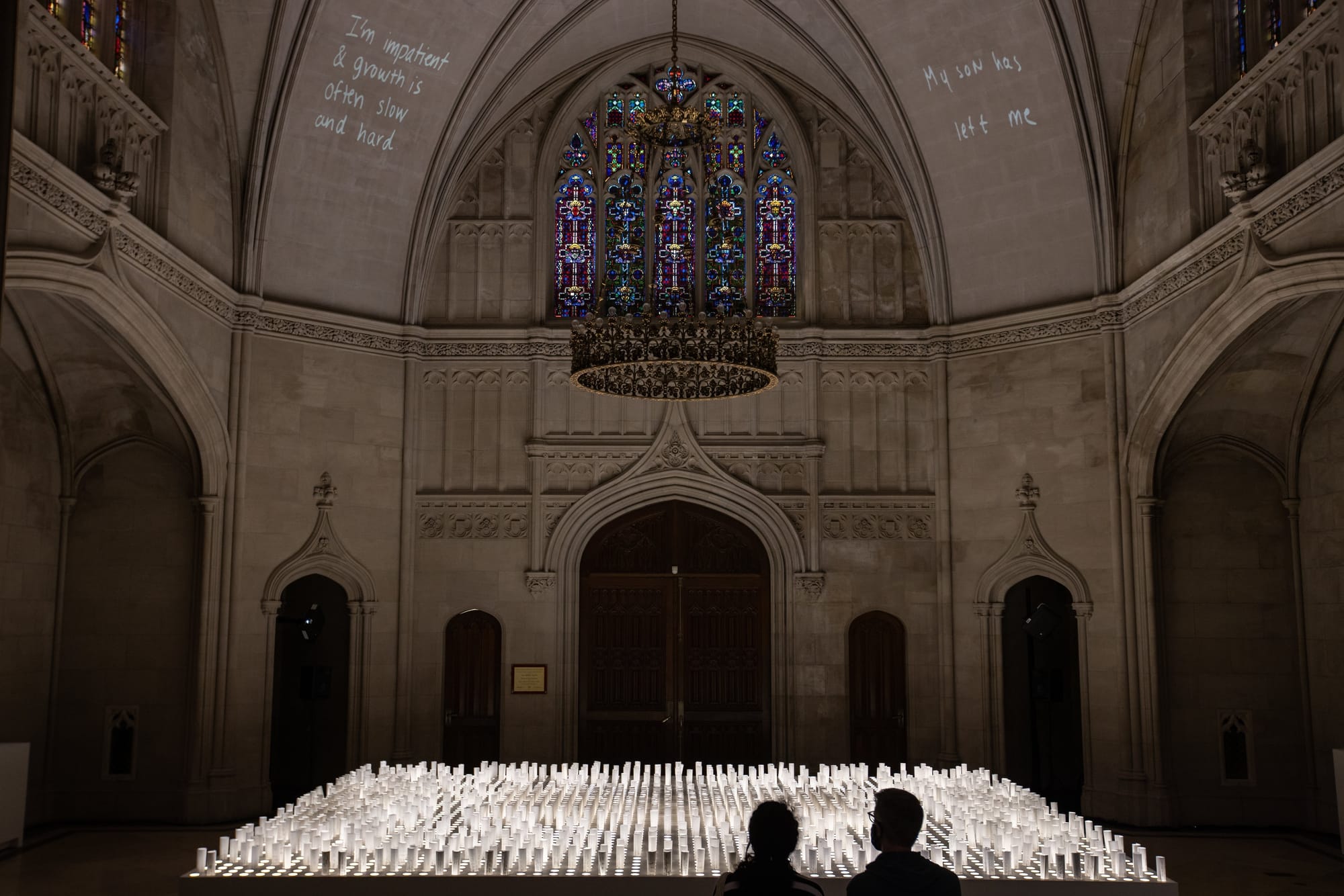
As one of the first garden cemeteries in America, Green-Wood Cemetery offers a contemplative respite for urban residents to commune with nature and restore perspective. After the End is a participatory public art installation in Green-Wood’s Historic Chapel dedicated to contemplating loss in all forms: the loss of loved ones, relationships, health, and worlds we once knew. And the practices that help us endure. 

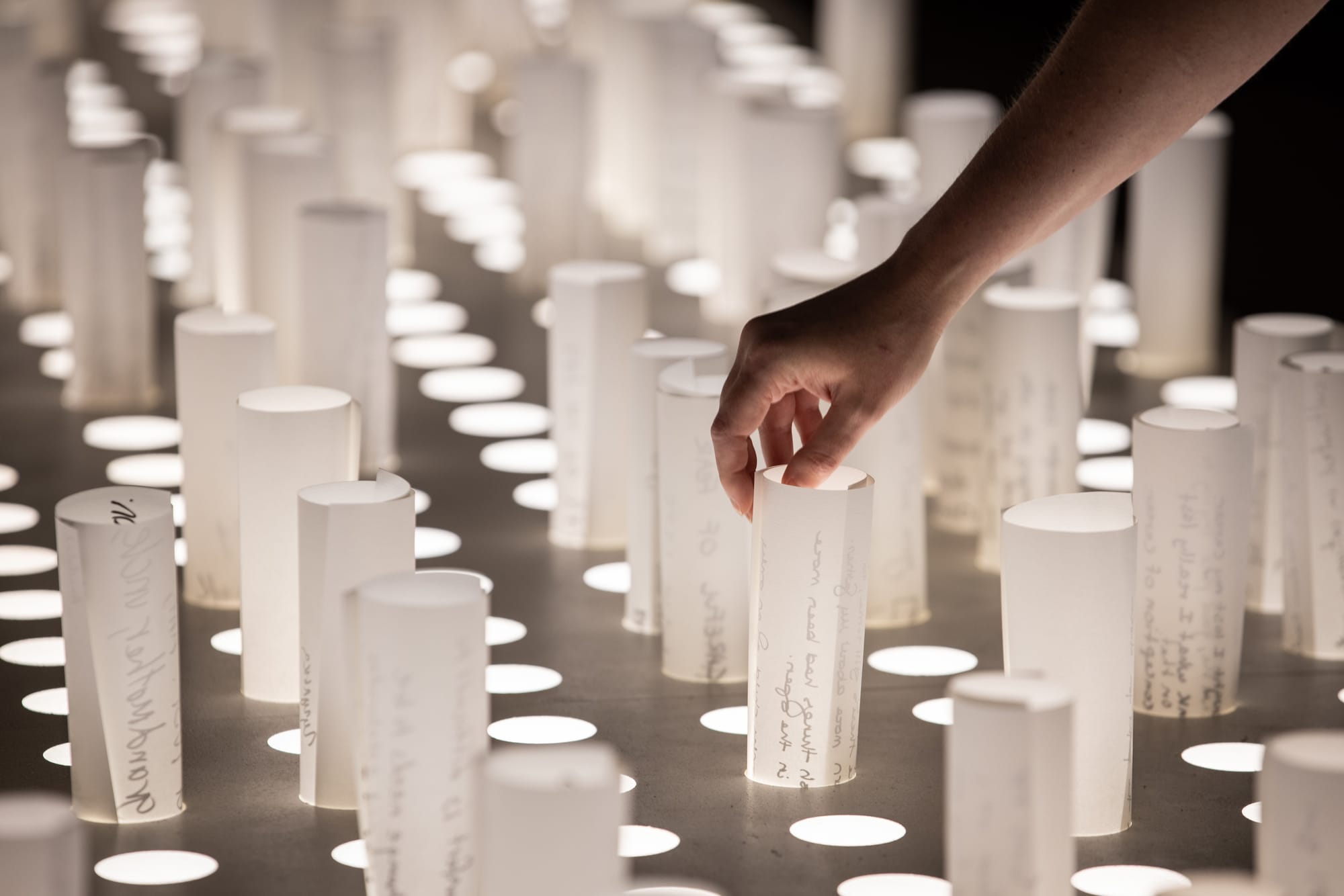
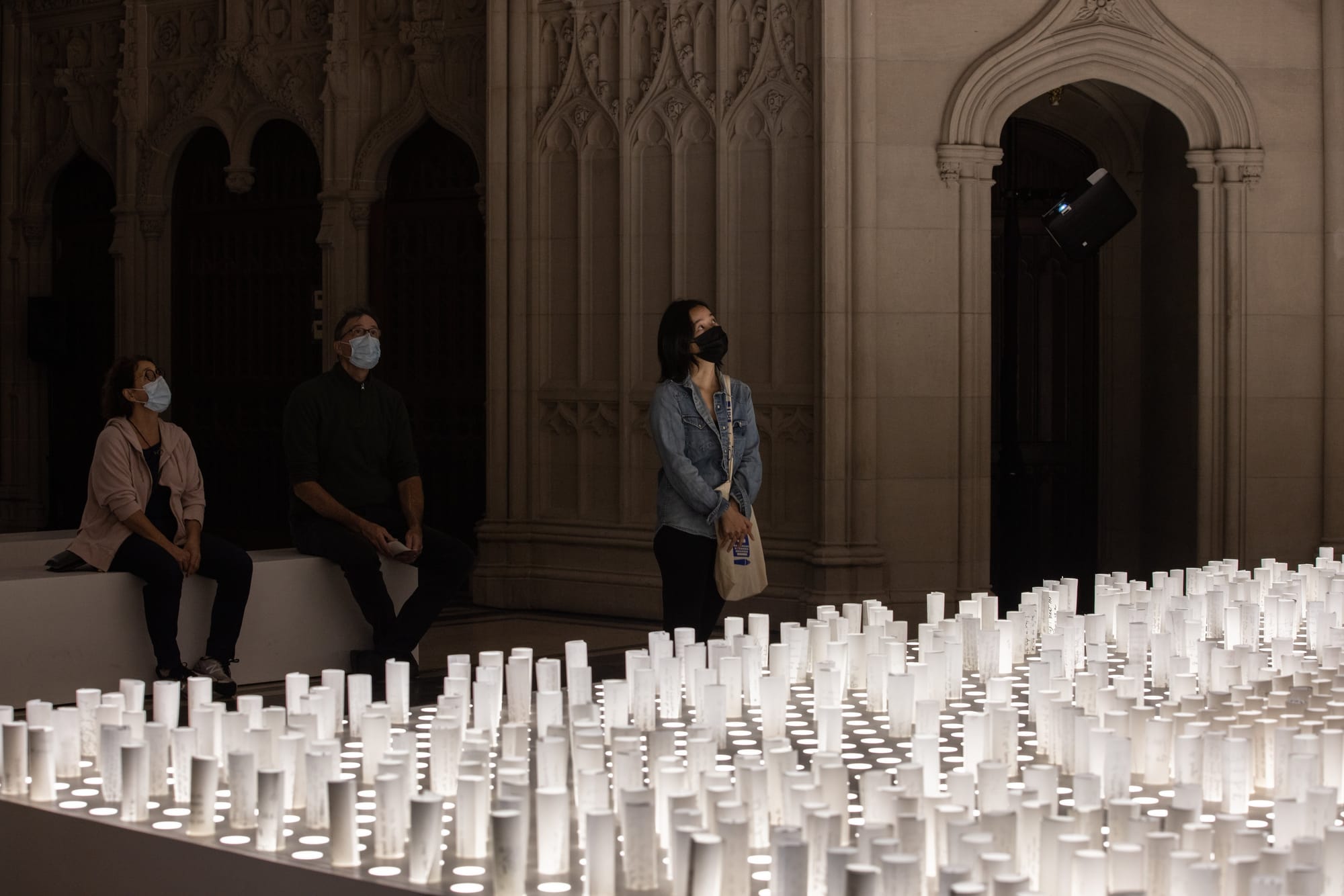
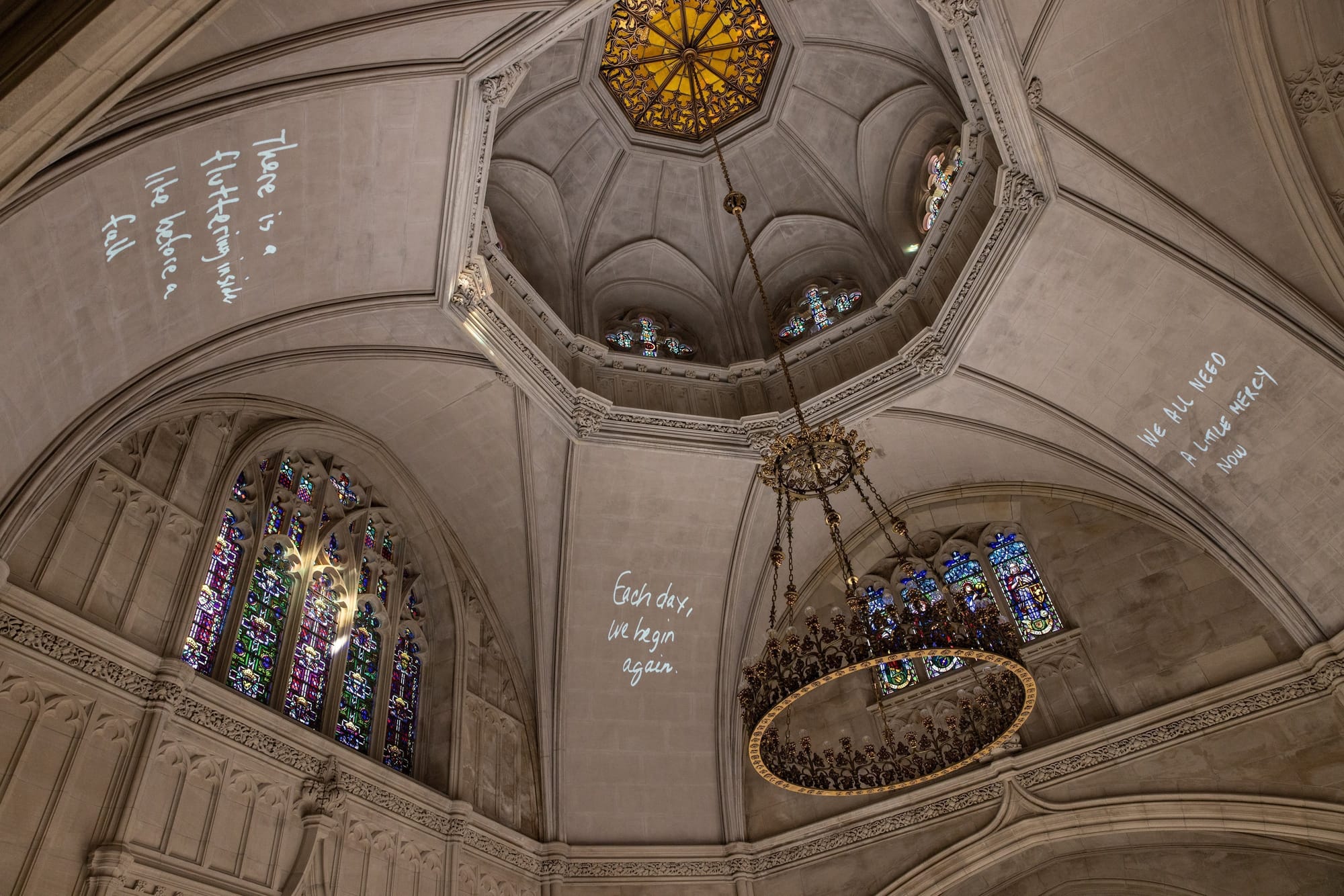
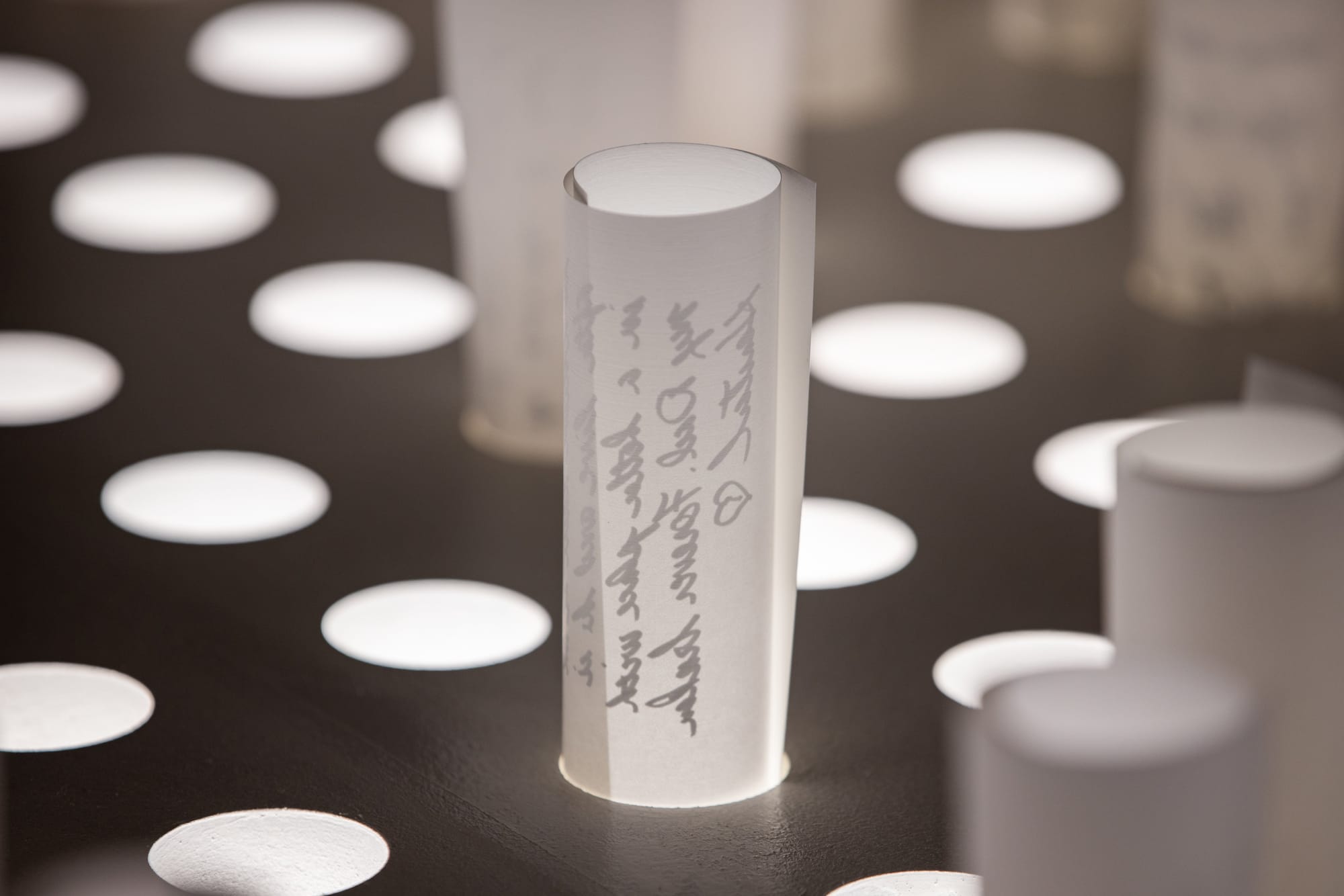
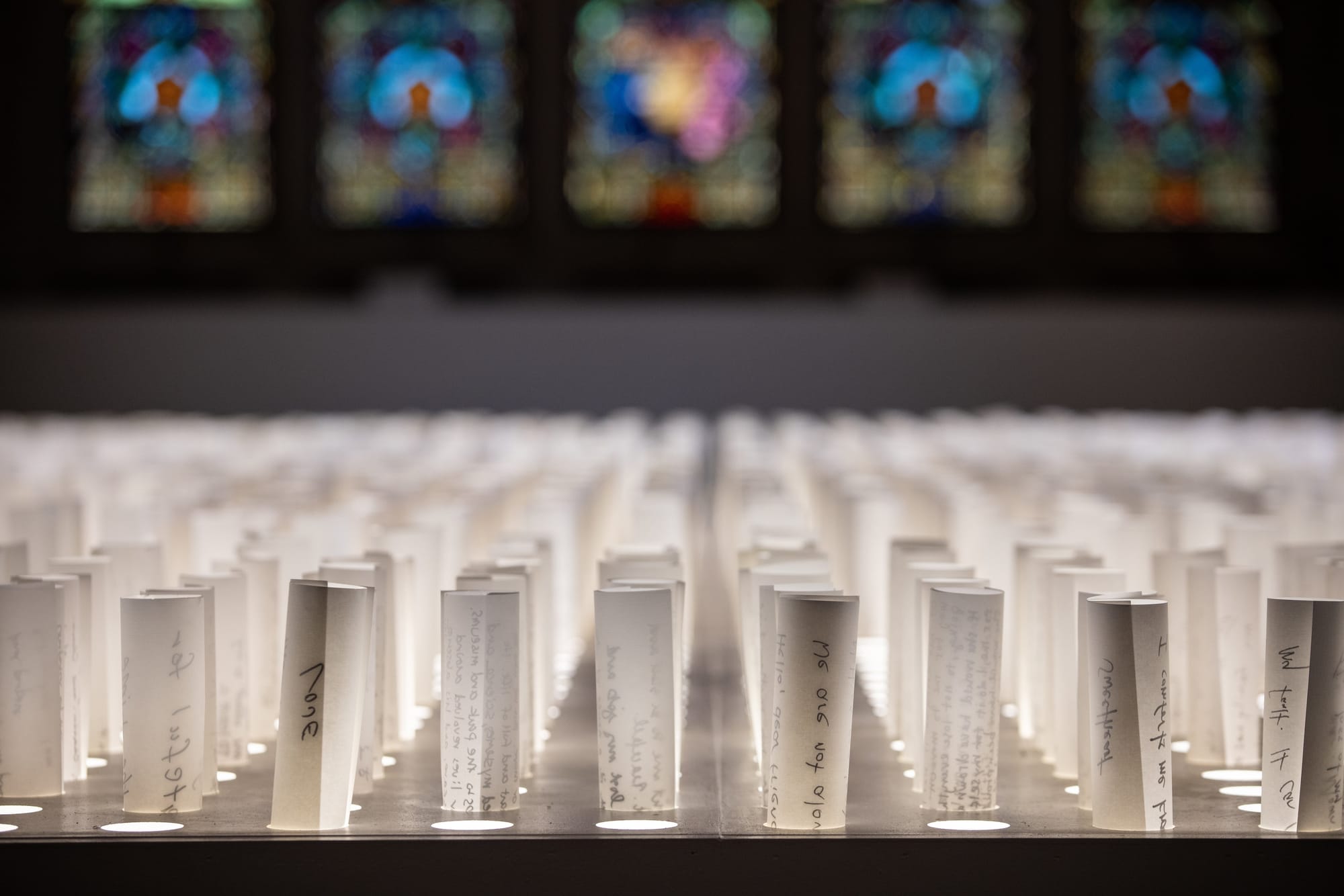
Candy Chang and James A. Reeves invite visitors to anonymously share their experience on a scroll and place it upon an illuminated altar. Lit from within, each response takes the form of a devotional candle, and together they create an evolving field of light. A cycle of projected reflections encourages visitors to contemplate the experiences of others as well as their own as they sit in the chapel’s apse, a rarefied space oriented towards the greater community. Set to an original score by Stephen Baker, the installation considers how we weather the difficult transitions in our lives.
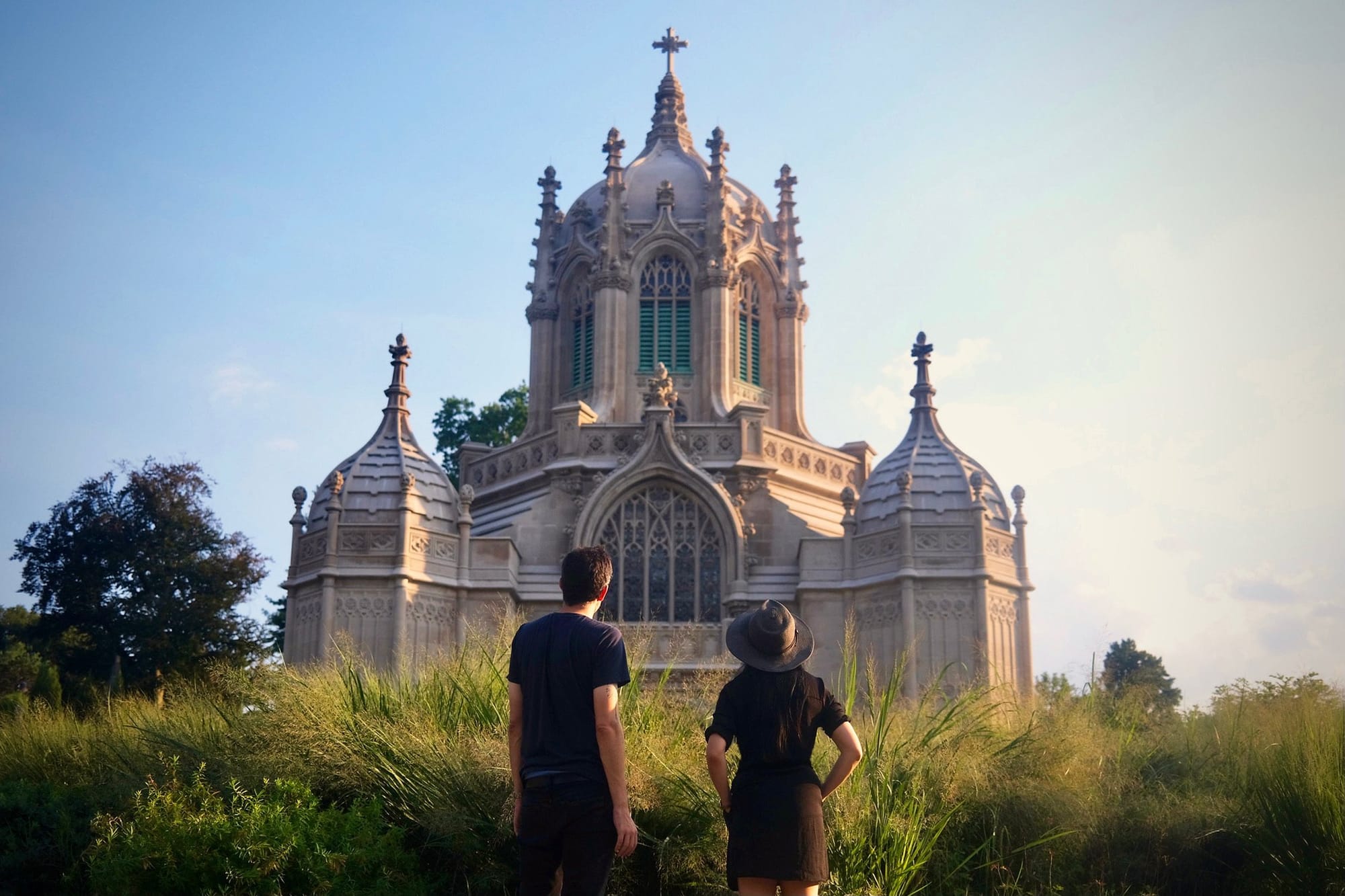
Inspired by the role of light in religious ceremonies and the visions of science fiction, After the End offers a refuge that reminds us we are not alone as we mourn the end of one reality and enter the next.

Over 5,000 letters were written about loss. Visitors have also shared the rituals and practices that provide comfort: I swim laps like he did… I eventually forgave you and now I feel lighter… The grief comes in and out like radio static… I am in recovery. I will find my way back… Trees comfort me. Faith exists in these hills… I bought a turntable and began to go through my father’s record collection, his musical legacy… I wish I had appreciated her more when she was still alive… Why did I let you go?… Every year we light candles for each of them… I’m more honest with myself than I used to be… I’ve committed to helping others who are affected by the very thing that took you from me… No matter how painful, I found myself during this time… We all need a little mercy now.
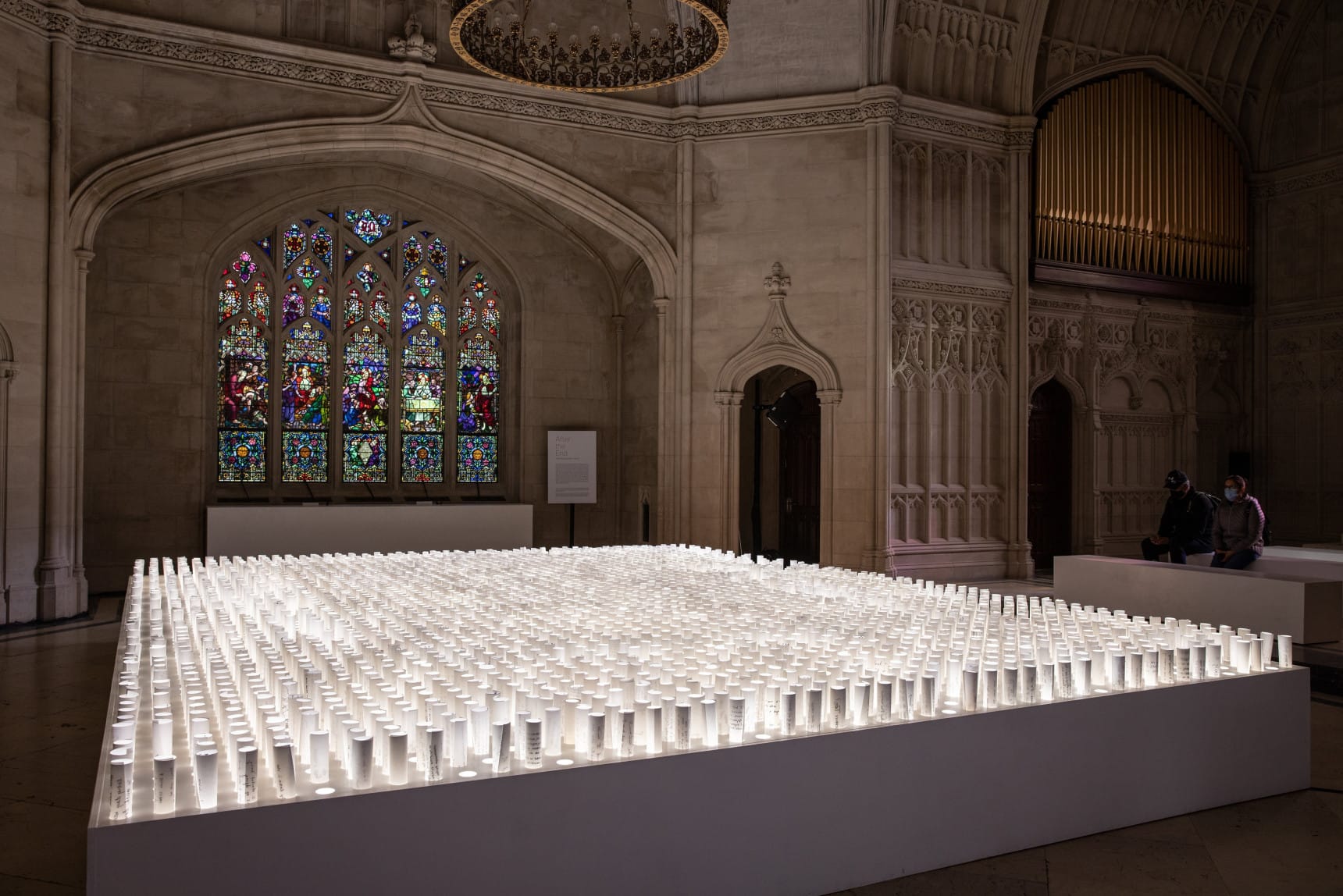
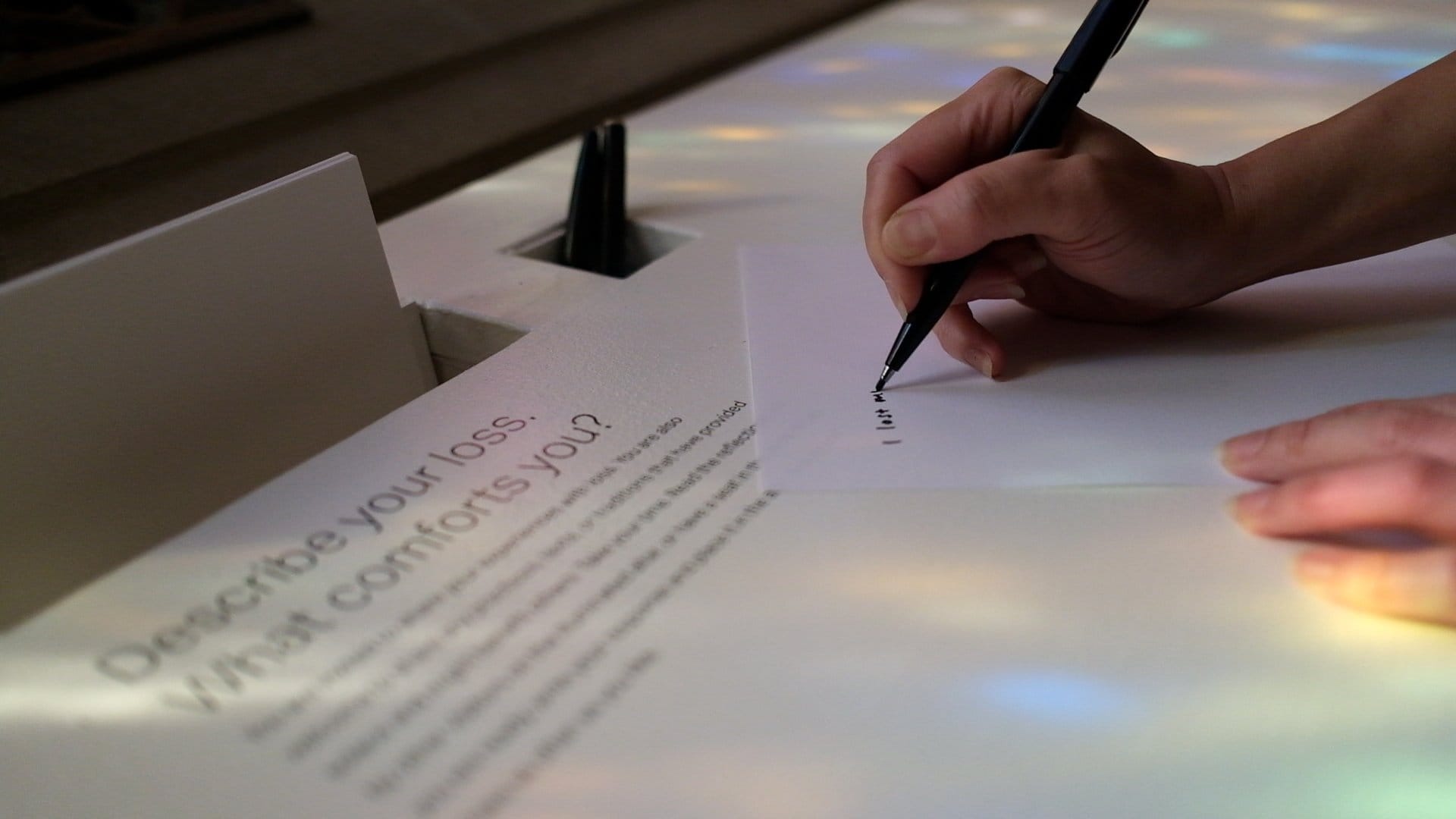
Photo by Walter Wlodarczyk
After the End is curated by Harry Weil, Green-Wood’s Director of Public Programs. Original score by Stephen Baker. Acoustic design by Connor Whiriskey. Video assistance by Rooftop Films. Fabrication assistance by KLN Studio, Frank Morelli, William Rivera, Pelegrin Rosario, Alex Hernandez, and Joseph Cubero. Archival assistance from Nadia Delisfort. This installation is supported with a grant from the National Endowment for the Arts. Photos by Walter Wlodarczyk.
The Nightly News

The Nightly News

"We are quite probably dreaming all the time, but consciousness makes so much noise that we no longer hear the dream when awake."
—Carl Jung

The Nightly News is a participatory video-based installation that illuminates the surreal scenes of anxiety and desire when we dream. Initially created at the American School in London and expanded at the Eli and Edythe Broad Art Museum, the ever-evolving video features thousands of handwritten responses from visitors describing the striking scenes that fill their heads at night. Presenting torn responses in reverse, the video speaks to the sensation of recalling a dream: sifting through scraps, searching for meaning beyond the reach of logic.

Themes have emerged: we fall, we flee, and we search for answers. We can’t get away, our teeth fall out, and we are strangers in a strange land. Devoted to the intensely private yet universally recognizable symbols that haunt us, The Nightly News reminds us that we’re all deeply weird creatures bound together by nerves, fantasy, and the unknown. Created in collaboration with Candy Chang.

2022, The American School In London, London, England. Projector, speakers, fabric, wood, seating, paper, pens, 36′ x 36′ x 10′ space. Installation assistance by Graham ‘Titch’ Fort, Joe Harris, Shane Murdock, Dean Hoffland, Mick Fernandez, and Youcef Benhadi. Organizational assistance by Jen Kirstein, Dean Evans, Gavin Hughes, and Cosmo Murphy. This installation is supported by the Innovator-in-Residence Program at the American School In London.

2023, Eli and Edythe Broad Art Museum, East Lansing, Michigan. Projector, speakers, wood, seating, paper, pens. Curated by Dalina Perdomo Alvarez. Organized by the Eli and Edythe Broad Art Museum in collaboration with Michigan State University’s International Studies and Programs. Special thanks to DEI Program Coordinator Anjam Chaudhary.
Light the Barricades
Annenberg Community Beach House, Santa Monica

Light the Barricades

Spanning four sites across the Los Angeles area, Light the Barricades is a series of electrified shrines. Combining the anatomy of billboards with the rituals of pilgrimage and silent contemplation, this work is inspired by the ancient I Ching, a philosophical system of diagrams first carved into the wall of a prison cell three thousand years ago. Believed to be one of the world’s oldest texts, the I Ching provides a guide for weathering the flux of life, particularly the emotional obstacles of resentment, judgment, and doubt—qualities that increasingly seem to dominate American life today.

Shining a light on the difficult emotions that thwart our progress, each lightbox represents an emotional barrier that fuses the widescreen perspective of Chinese landscape paintings with today’s textures of metal, noise, and alienating architecture. Passersby are invited to walk alongside each lightbox while reading an illustrated fable before sitting for a five-minute reflection with an illuminated hourglass and a pointed question about resentment, judgment, or doubt.

Commissioned by the Annenberg Space for Photography, these solar-powered lightboxes first appeared at Grand Park, the Annenberg Community Beach House, and the Natural History Museum of Los Angeles County before the Annenberg Space for Photography presented them as a collection as part of Walls: Defend, Divide, and the Divine, an exhibit that examines the historical use and artistic treatment of walls over centuries. Extending into the museum’s gallery, this project encouraged visitors to anonymously share their challenges while considering the experiences of others through an audio-video installation of selected responses. Over 3,000 handwritten reflections were collected, many of which are featured in a book that collects the fables and artwork from the project. Chang and Reeves created an original soundtrack for the gallery installation, which appeared in an anthology of ambient music by Brooklyn label Mysteries of the Deep.

A Monument for the Anxious and Hopeful

A Monument for the Anxious and Hopeful

These are challenging times. One in five American adults suffers from an anxiety disorder, and the rate ticks higher every year. Loneliness has become a public health epidemic. Political tribalism has doubled in the past decade, calcifying into outright loathing of “the other side.” But we don’t need surveys or statistics to tell us there’s a strange energy in the nation, something nervy and needy like an unwanted presence in the room. We see it everywhere. On our screens. In the streets. At the kitchen table. In the mirror.

In these days of alienation and polarization, we believe infrastructure for the soul is more necessary than ever. Although we share more in common with one another than anything that divides us, it feels as if we’ve forgotten how to have conversations, particularly the important ones that might help us reclaim some shared terrain. The discussions about the dreams we nurture and the reasons for our fears. The exchanges rooted in curiosity rather than judgment. The interactions that help us feel less alone.

Rubin Museum of Art, New York

In 2018, Candy Chang and I created A Monument for the Anxious and Hopeful at the Rubin Museum of Art in New York City. Free to all passersby, this year-long participatory installation invited visitors to anonymously write their anxieties and hopes on vellum cards and display them on a 30’ x 15’ wall for others to see. The anonymity of these responses offers an antidote to digital fatigue. Our screens have reshaped the way we communicate so completely that there are very few places we can express ourselves in public today without feeling as if we’re performing for a scoreboard of hearts, stars, or thumbs-up icons. Seeing a private corner of your psyche expressed in a stranger’s handwriting can be incredibly reassuring, and it’s a step towards seeing ourselves in one another.

Rubin Museum of Art, New York

With each passing week, the wall grew into a monolithic barometer of the year’s emotional weather. Vivid fears in the wake of each mass shooting. Agitation and hope amid election season. And ongoing concerns about relationships, addiction, debt, and distraction, as well as inspiring reflections on compassion, family, and embracing change. As the responses continued to accumulate throughout the year, the wall became a consoling and enlightening site where visitors could glean the prevailing mood while exploring over 50,000 individual meditations ranging from deeply personal reflections to broader political, spiritual, and psychosocial statements.

2018, Rubin Museum of Art, New York, NY. Vellum, wood, acrylic, 31′ w x 12′ h. A collaboration between Candy Chang and James A. Reeves for the exhibit Future Is Fluid. Project management by Jane Hsu. Exhibition design management by John Monaco. Installation assistance by Robert Paash, David Wilburn, Andrea Pemberton, and Muoi Ly.
The Atlas of Tomorrow

The Atlas of Tomorrow

We tell ourselves such strange stories. Stories like I am not good enough or I will never be understood. We hear these words in the private chatter, the idiot hum in our heads. This voice is a village crowded with heroes and cowards, a chorus of teachers, dreamers, and thieves fighting for our attention and telling us who we are. But sometimes, we catch a glimpse of who we might become. Perhaps it’s a rogue thought in the shower or a shiver of déjà vu on the sidewalk, but for a moment, our mental weather clears, and the world makes some kind of sense. They call this synchronicity, when our insides meet the outside in a meaningful way. You might call it gut sense or intuition, but you know when it happens. It’s encoded in the hairs on your neck, the flutter in your nerves, and it’s been within you all along, a deep prehistoric knowledge that occasionally breaks to the surface before disappearing beneath the next wave of chatter. This mural was designed to make these moments happen more often.

Conceived by the artist Candy Chang, The Atlas of Tomorrow is an interactive mural in Philadelphia that invites passersby to consider a dilemma in their lives, spin the dial, and consult a fable inspired by the I Ching, the ancient Chinese text that examines the inevitability of change. I wrote sixty-four short stories that blend the lessons of the I Ching with classic archetypes that highlight the different personalities we carry within us. The result is a collection of dispatches from ‘the town in our head’ that introduces a surreal world of endless winters, murderous sunflowers, and rotting cars to describe familiar anxieties and passions.

10. The Lion

Last week a lion came to town. Naturally, we were terrified. He stalked our streets with his tail swishing behind him, snarling and lunging at anyone who came near. We gathered on rooftops and watched from a distance, too frightened to return to our offices and homes. He ate mailboxes and brutalized small cars; he was taking apart the post office with his teeth when a little girl came skipping down the street. She bounded towards the beast with outstretched arms, chanting Mr. Lion, Mr. Lion as if he were a stuffed animal that had come to life. She giggled as she picked up his tail and began skipping rope. We gasped. We covered our eyes. But the lion simply sighed and settled down for a nap. When approached by such a cheerful and harmless creature, what else can you do?

Approach your adversaries with kindness and no harm will come to you. Your behavior will determine the well-being of your community and yourself. Integrity is louder than words.

18. The Cars

Our cars began to roll over and die in the streets. At first, it was just a few convertibles and sedans, but by late afternoon, hundreds of cars and trucks lay on their backs in the rush hour sun, their wheels pointed at the sky. Nobody wanted to clean up the mess, and we spent weeks arguing about the cause. We formed committees and held hearings to assign the blame. Meanwhile, our cars remained upside down, and we could not go anywhere. Months passed. Birds made nests in the wheel wells, and grass sprouted from engines, axles, and transmissions. One day, we realized that nobody was coming to clean this up. There was no cause, and there was no one to blame. It was just one of those things. That night, we gathered in the streets and began to rock and tip our cars until the world was right again.

Rather than worry about the cause of unfortunate circumstances, improve the situation. Repair is vital to growth.

58. The Smile

There once was a woman we loved to see. She had a lovely smile that would spread from her face to ours. It was not the type of grin that appears when you hear a clever joke, or you’ve been tickled but the elegant smile of someone who has learned a bit of wisdom through the years and might even be satisfied with life. Whenever she entered a room, her smile was a welcome and reassuring sight, and we sat a little straighter and felt a little brighter. One day, somebody whispered in her ear, and it must have been quite a joke, for her gentle smile grew into a jack o’lantern grin, and we smiled too at first—but then her smile grew so big and wide that we became frightened, although we could not quite explain why.

Emotions are contagious. Joy comes from curiosity and truth, and must be balanced with dignity if it is to last.