1
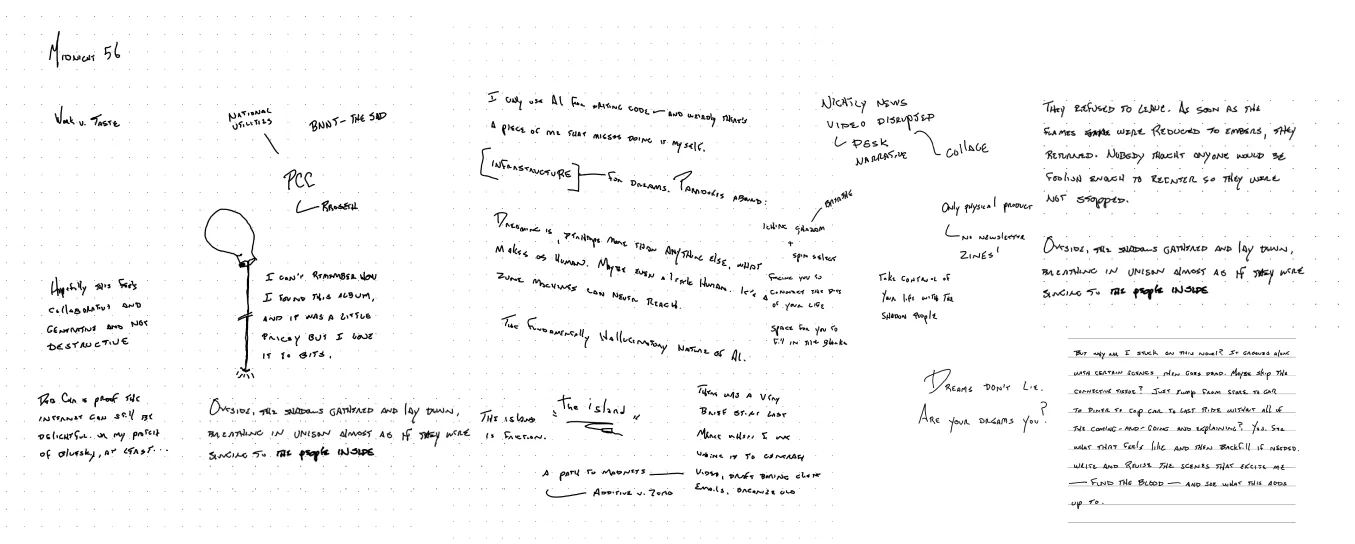
There was a time when I would tell people I did not dream. If they did not believe me, I'd say okay maybe sometimes I dreamt about shapes and colors. This went on for about fifteen years. I thought talking about your dreams was childish, even a little tacky. Looking back now, I realize I did not want to cop to the parts of myself that were squishy and unknowable. I needed to believe I was a rational man, powered solely by reason and will. Not anymore. Today I crave the murk and the mess and the mystery. Now I agree with John Steinbeck’s admonition that “people who are most afraid of their dreams convince themselves they don't dream at all.”
2
There were a few days last spring when I used artificial intelligence to draft client proposals, generate videos, and catalogue nearly a million words of scattered writing. The results were absolutely dead. I had no connection to this material. I deleted it and moved on. Better to make something embarrassing that etches a memory and points me in new directions. Better to take the risk of a client saying they don’t understand what I’m trying to express.
Today I use artificial intelligence primarily for two things: 4% is for spotting typos in a final draft. It’s not very good at this, but it’s nice to have another pair of eyes on words like ‘bureaucracy’ and ‘graffiti’. (When it comes to actual ideas and darling-killing, I will never find a better editor than C.) And 95% is for writing code. Part of me misses writing CSS and PHP myself, but not enough to be unrealistic. Claude’s code is faster and better than mine, which frees me up to focus on more creative things. Like dreams. This is where the remaining 1% comes into play.
A few months ago, Olly and C. and I used Claude to build an app called Dream Club because we want to make infrastructure for dreams. Although I enjoy using it to organize and analyze my dreams, I have mixed feelings about it. More than anything else, dreaming is what makes us human, even a little magical. It's a zone the machines will never reach. Yet paradoxes abound, and the hallucinatory nature of artificial intelligence seems very much related to the opaque logic of dreams.
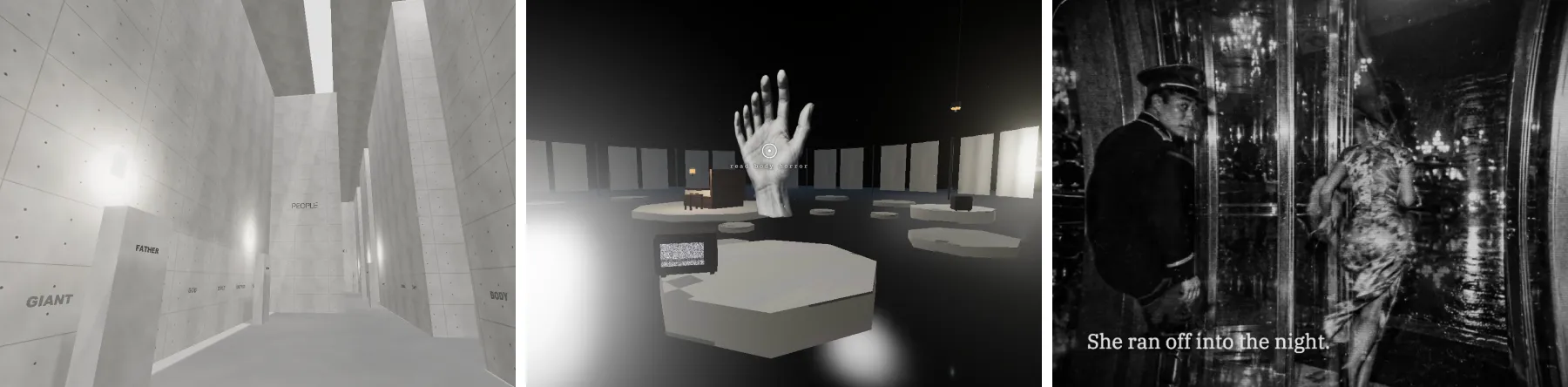
Last week, we wired up Dream Club to a PlayStation engine, which allowed us to watch and even play our dreams. There was a delightful sense of slippage at first, seeing the half-remembered murk of a nightmare in 32 bits. I stayed up late with Claude, building a dream museum in the style of Tadao Ando that played a strange TV station. At first, I was thrilled to see my dreams about six-fingered hands and murderous women become static-ridden footage on soaring concrete walls. Then I began to worry.
Is artificial intelligence generative or a zero-sum game? Does it feed or rob the imagination? When I posed this question on the internet, Will Ellwood replied that “it not only mugs the imagination at knifepoint, but leaves the victim permanently injured.” A few days later, Marty described my unease well: “When you read the book after seeing the movie, you’re trying to get your freedom back.” Strong opinions, but these are intense times.
3
Lately I've been dreaming about an island, overheated and obscene, choked with vegetation that seems to be breathing. A tinny song by the Thompson Twins is always playing in the distance for reasons I do not understand. Hold me now. Warm my heart. There are spider bites across my back and cobwebs in my hair as I scramble through the undergrowth towards the music. But the only technology on the island is an overhead projector. I first visited this island in the early summer, and every few weeks I return. Always the same song, always the same feverish sensation of friction.
Friction is the thing, isn't it? Dreams are friction, resisting clear explanations and reasons. Writing is nothing but friction. And so is the busywork of sketching, designing, organizing, and searching. This is where new discoveries and energies emerge. Friction creates the scaffolding for memories. But C. thinks the real fight is to preserve ambiguity. Are ambiguity and friction the same thing? I need to ponder this. In the meantime, the better path is to make dream collages with C. or pair my dreams with a tranche of 1970s family photos that resonate with six-fingered hands, mysterious islands, and judgmental giants for reasons I do not understand. And don't need to.
In my dreams, I can never operate a device or screen. It always displays the wrong thing or the interface is garbled. Perhaps this is a blessing. Or a message.
4
But Deb Chachra is proof that screens can still be delightful. A chance connection through Adam Greenfield, a mutual friend on Bluesky, led to some nice emails. When she asked if I was going to MUTEK, my initial response was of course not. I'm not the kind of guy who jets off to a techno festival but . . . maybe I could be? So C. and I went to Montreal and had so much fun that we're planning to go again next year. So thank you, Deb, for expanding my sense of the kind of guy I am.
Speaking of expansive: she wrote a book about infrastructure, which reminded me the world is full of miracles because I did not expect a book about infrastructure to be so damned readable. She makes the wiring of our world personal, interweaving stories while unpacking how we treat the water from our faucets (if we think about it at all) like the sunrise: a mundane mechanism that should be wondrous. Her writing carries the increasingly rare faith (and proof) that we have agency, that we are capable of building a better world. From now on, I will always think of bridges, dams, and transit stations as the "megafauna" of our experiments with civilization, which is a beautiful gift.
I'm so happy she's with us tonight because she sent me a wild tracklist of old classics and big new sounds. But first, the mandatory Midnight Radio interview question:
5
Do you believe in a god or any spiritual dimension to the universe?
“We use the word ‘belief’ in wildly different ways. We use it for things for which the evidence is absent or disputed (like ghosts), where something is intangible but exists insofar as our belief makes it so (like justice), or even where the whole point of believing is to do so in the complete absence of evidence, if not outright contradiction (some conceptions of gods). And we also use ‘belief' for things that, if not incontrovertible, certainly have the weight of evidence in their favour, like ‘I believe that the sun will rise tomorrow.’”
“My parents were at the leading edge of the wave of non-European immigration that would go on to transform the city of Toronto, so when I was a child, it was still culturally very British. I was effectively raised Anglican by my public school, including saying the Lord’s Prayer in class every day and pancakes on Shrove Tuesday (instead of Carnevale or Mardi Gras—not for nothing was it ‘Toronto the Good’). Our family had household shrines to Durga and Shiva and we celebrated Hindu holidays like Diwali at home, although we did go to mandir a handful of times each year. Many of my parents’ friends were Sikh, and every month we went to a gurdwara service held in the gymnasium of a local school. All of this meant that my upbringing was kind of a reverse Pascal’s wager—when you’re raised in three different religious traditions, it’s pretty hard to believe in the veracity of any of them, especially if you’re the kind of nerdy, precocious child who, when she’s sent off to Sikh sleepaway camp for a week, asks the adults questions like, ‘why are you not allowed to cut your hair but you are allowed to cut your fingernails, when they’re made out of the same stuff?’”
“Being a nerdy, precocious child growing up when and where I did also meant that, when I looked up from the campfire to the starry sky above it, I knew I wasn’t seeing holes pierced in a scrim suspended above our heads. Even as a kid, I understood that every one of the thousands of points of light I could see was a star like our sun, that I was looking hundreds of thousands of light-years out into space and also deeper and deeper into the past. Like most people, I go about my daily life traversing what is effectively a plane, thinking about time in minutes or days or maybe years, with my sightlines mostly measured in metres but occasionally miles, and governed by all the narrative solipsism implicit in being a self who is looking out through my eyes as my body moves through space and time. But give me a few minutes on a clear, dark night and I will self-induce existential vertigo with just the dizzying perspective shift to seeing myself—and everything and everyone I know—as an infinitesimally small speck surrounded by a vast ocean of stars. Ladies and gentlemen, we are floating in space.”
“So I am permanently reconciling, or at least wrestling with, this celestial awareness alongside my quotidian human activities and desires. I don’t believe in gods or prophets. I do believe that we are not alone in the universe, despite the lack of direct evidence, because my solipsism doesn’t extend to believing that all the stars in all the vastness of time and space are just for us, especially not when that same vastness explains why we haven’t crossed paths with others. The spiritual dimension of the universe, for me, follows directly from its physical dimensions: I believe that the universe is huge and uncaring and in it we are insignificant on cosmic time scales, and so we ourselves have to be close and caring for our little blue planktonic dot and all who inhabit it.”
6
Synchronicities abound: Deb inadvertently namechecked my tattoo that says "ladies and gentlemen, we are floating in space" because it's my favorite song. Unfortunately it's grown illegible as I age.
For tonight's broadcast, Deb wanted to "somehow capture the feeling of being up too late or awake too early and seeing the dark night of bright artificial lights turn to cold grey autumn morning." Even though it's still 80 degrees and I'm seasonally disoriented, this mix carries the promise of Octember. In addition to some musical megafauna from the Jesus and Mary Chain, Radiohead, and Low, Deb's selections introduced me to new favorites like the Inuit singer Elisapie (who does an incredible cover of the Cranberries' 'Dreams') and James Ellis Ford.
- The Weakerthans - Utilities (Vocals) + The National - Lucky You (Vocals)
Reunion Tour • Epitaph, 2007 • Bandcamp + Sad Songs for Dirty Lovers • Brassland, 2003 • Bandcamp - PCC - Sterniq
p/n-oise • Nocuedo Editions • Bandcamp - Low - All Night
Hey What • Sub Pop, 2021 • Bandcamp - The Jesus and Mary Chain - Just Like Honey
Psychocandy • Blanco y Negro, 1985 - Massive Attack vs. Mad Professor - Mezzanine
Mezzanine • Virgin, 1998 - Skinny Puppy - Assimilate (Instrumental demo • 47% slower)
Bites • Nettwerk, 1985 • Bandcamp - Alex Smoke - We Like It Insipid
Paradolia • Soma, 2006 • Bandcamp - James Ellis Ford - This Too Shall Pass
Lost in Another World • Domino, 2026 • Bandcamp - Radiohead - Idioteque
Kid A • Parlophone, 2000 • Bandcamp - Elisapie - Arnaq
The Ballad of the Runaway Girl • Bonsound/Yotanka, 2018 • Bandcamp - Tomo Akikawabaya - Mars
The Invitation of the Dead • Minimal Wave, 1983/2016 • Bandcamp - Jóhann Jóhannsson - The Cause of Labour Is the Hope of the World
The Miners’ Hymns • Recorded in Durham Cathedral, 2010 • Bandcamp - David Sylvian - Let the Happiness In
Secrets of the Beehive • Virgin, 1987 - Skinny Puppy - Assimilate (Midnight Radio Bronchusrhubarb96 Mix)
Here at Midnight Radio, transparency is a Core Value, so here are the alterations I made:
- I ripped out the vocals from The National and The Weakerthans and sprinkled them over a track from my current obsession, a guitar-dub trio from Chile called PCC.
- I haven’t thought about Massive Attack in ages, so seeing 'Mezzanine' on Deb's list reminded me of an all-time formative album from the 90s, Mad Professor’s dub remix album, No Protection, which is so deeply worn into my brain that I’m always startled to discover this isn’t what Massive Attack actually sounds like. I also didn't realize he remixed Mezzanine as well. It was inexplicably shelved, then quietly released in 2019. So I included a dub-crazy version that I think still fits the bleary-eyed brief. (Along the way, I discovered Mad Professor recently made some of the original 20+ minute demo reels of No Protection freely available.)
- Added a song from Tomo Akikawabaya, who dropped a brilliant album in ’83 then disappeared. For the past year, I’ve been hoping to find a home for 'Mars', an odd darkwave track. I think this is it.
- Skinny Puppy's 'Assimilate' frightened me, so I swapped in the demo version and pitched it down until it became more of a sci-fi noir thing, albeit a bit more Cronenberg than Blade Runner. And at the end of the mix, I slowed it down 250% and added some harmonics that sound like an early Autechre or Aphex Twin misfire.
In other mixtape news, it was a happy surprise to hear my Carthage track pop up in Grant Aaron's plush installment for the Deep Breakfast Series. I'm even more excited about the song that appears at the 28-minute mark, which is flat-out gorgeous: "It's Always Late" by Rookas.
Thank you for listening.