June 15, 2026
"An age so fragmented that there’s a weird emergent new form of unity."
1
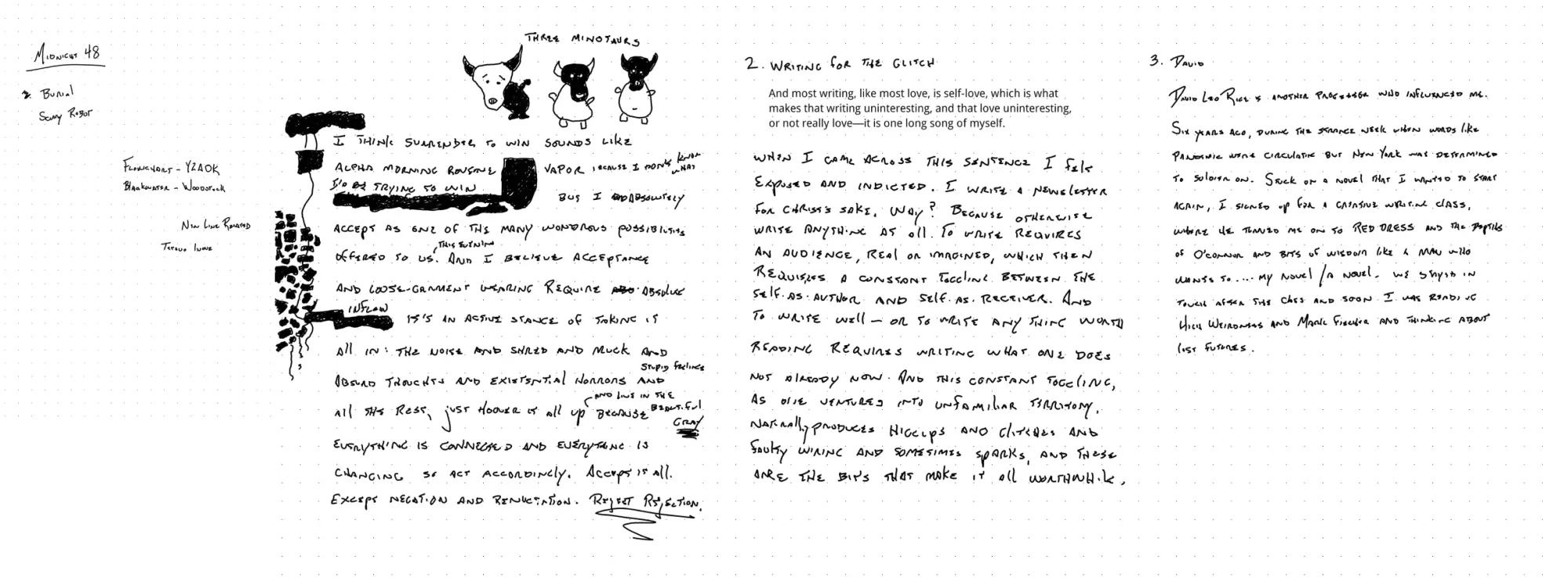
At my Thursday night Men's Spirituality Book Club, we've been debating the recovery cliché that "acceptance is the answer," which sounds so limp and lazy.
But I'm learning that acceptance is not passive. Wearing the world as a loose garment requires a difficult and oftentimes exhausting stance that makes room for total inflow: the mental shred, pixellated heat, and humiliating muck that comes with being alive in this absurd century, not to mention the stupid feelings and existential jitters that are part of simply being a person.
In the end, there's no workable choice other than to hoover it all up and learn to live in the beautiful grey because everything is connected and always changing. So accept it all. Except negation. I reject rejection.
2
But then I came across this sentence from Simon Critchley that I find difficult to accept:
And most writing, like most love, is self-love, which is what makes that writing uninteresting, and that love uninteresting, or not really love—it is one long song of myself.
Reading this, I felt exposed. After all, I write a newsletter of all things. Is this an act of self-love? Perhaps, although it usually feels more like self-loathing, especially when I cannot get my sentences to behave or an episode to sound how I think it should, which is most of the time.
But if not for this habit, I might not write anything at all. To write requires an audience, real or imagined, which generates an interesting flicker between the self and not-self: the self as author and the self as receiver. This flicker is where the action lives. It creates mistakes and glitches, but also sometimes sparks, which makes the whole undertaking feel worthwhile.
To write anything worth reading requires writing something I do not already know. I learned this lesson well twenty-something years ago when I was a graduate student receiving bleak red letters on my essays about Plato, Rousseau, and Freire. I thought I understood the material and was writing clearly enough, so I asked my professor why I was failing. She smiled as if she’d been waiting for this question. “When you write something you don’t know the answer to,” she said, “I’ll give you an A.”
Ten years ago, I tracked her down at a dinner party to thank her for changing how I write and think and teach. When the party drifted toward the hors d'oeuvres, she took me aside and asked for a hug. I realized how important it is to say these things to people while I can, to let them know how much they've influenced me along the way.
Which is the reason for this year’s special guest series.
3
David Leo Rice is another professor who influenced me. Six years ago, I was stuck on a story that I wanted to start again, so I signed up for a creative writing class at the school where I teach. This was during the strange weeks in New York when rumors about a sick lawyer in Westchester were circulating like a virus but we took the subway anyway and went out to eat and laughed and coughed on each other. So I was already primed for the uncanny when David turned me on to writers like Aimee Bender and Steve Erickson, as well as bits of wisdom like a man who really wants a sandwich is more interesting than a man who sort of wants to cure cancer. We stayed in touch after the class, and soon I was reading High Weirdness and Mark Fischer and thinking about lost futures.
David's stories also broadened my perception. The New House is a fable about the headfuck of creation that I'd like to press into the hands of every artist, writer, and seeker I know. His stories have renovated the architecture of my nightmares, especially The Hate Room, and I can’t wait to receive my copy of his latest collection, The Squimbop Condition, which follows a pair of time-addled brothers who “leave a trail of chaos in their pursuit of an impossible mission: to bring about the Golden Age—over and over again.”
Every few months, David and I have long telephone calls in which we walk around our respective cities and sanity-check our understanding of an increasingly illegible world. Each time we sign off, I'm heartened by his cheerful rejection of nostalgia, which is crucial for acceptance of any kind, and by the way he embraces the mess of our culture to map new routes to the sacred.
And David is with us tonight to discuss the age of the holy spirit. But first, he must answer the official Midnight Radio interview question.
4
Do you believe in god or any spiritual dimension to the universe?
"Yes, I feel quite certain that there are dimensions and powers beyond our comprehension, at the very outer edges of our awareness. The human condition, as I've experienced it so far, is to be able to grasp the presence but not the nature of these 'things,' whatever they may be—to know that something is out there (or 'in there,' because I think the innermost part of the imagination merges with the outermost limits of perception), but never to grasp what it is. This is why dreaming, talking, drawing, and writing are so important to me, because they feel like a way of harmonizing and playing with these presences, and finding a means of enjoying rather than suffering from the fact that we can never know what they really are, nor can we ever forget that they're there, on the margin and at the center of everything. Perhaps, therefore, this form of play is the same as prayer—it's not a means of asking for something, nor of pledging loyalty in the usual sense of that term, but of enacting a playful and dynamic relationship with the forces that make us who we are, and whose nature we can never grasp."
5
Tonight's episode opens with six minutes of David reading a few bits from his latest essay, "Master of Puppets: On My Mother’s Death and the Last Chapter of the History of the World," after which we discuss acceptance versus surrender and how to act accordingly in an age of grief and algorithms. I'm cheered by how he presents the act of reading and writing in 2026 as a holy covenant.
This was a ninety-minute conversation that I've chopped down to 29 minutes, and I’ve exorcised myself from the recording because 1) I like the odd shape that remains, the abrupt shifts that suggest an invisible logic; and 2) I cannot tolerate the sound of my voice or laughter (but Marty is helping me deal with this by making me do argumentative videos).
Because David says things like "in a dead world, mediated by a dead internet that is spawning its own undead successor," I wanted this broadcast to sound like an eerie late-nite transmission, the sort of thing that bleeds across your dashboard in the fog of a cross-country drive. It's laced with static, sighs, and mumbles, and I mangled David's voice until I forgot what it sounded like, searching for a zone between legibility and illegibility which, I think, is where the holy ghost lives.
Here are the songs that cycle in and out of tonight's broadcast:
- Burial - Strange Neighbourhood
Antidawn • Hyperdub, 2022 • Bandcamp - Blasé Saint - Lifelover (17% slower)
Matryoshka • Sferic, 2026 • Bandcamp - Kali Malone - The Spectacle of Ritual
The Sacrificial Code • Ideal Recordings, 2019 • Bandcamp - Flowchart - Y2AOK (68% slower)
Pre-2000 Singles and Comp Tracks • 1997 - Romance & Dean Hurley • White Lace and Promises
In Every Dream Home A Heartache • Ecstatic, 2022 • Bandcamp - Yassin Omidi - Lineup
Electronic Wave Function • Mosaic, 2025 - Datacide - Sixties out of Tune (41% slower)
Flowerhead • Rather Interesting, 1996 • Bandcamp - Blackwater - Woodstock (35% slower)
Istanbul/Woodstock • 2018 • Bandcamp
Download • Podcast