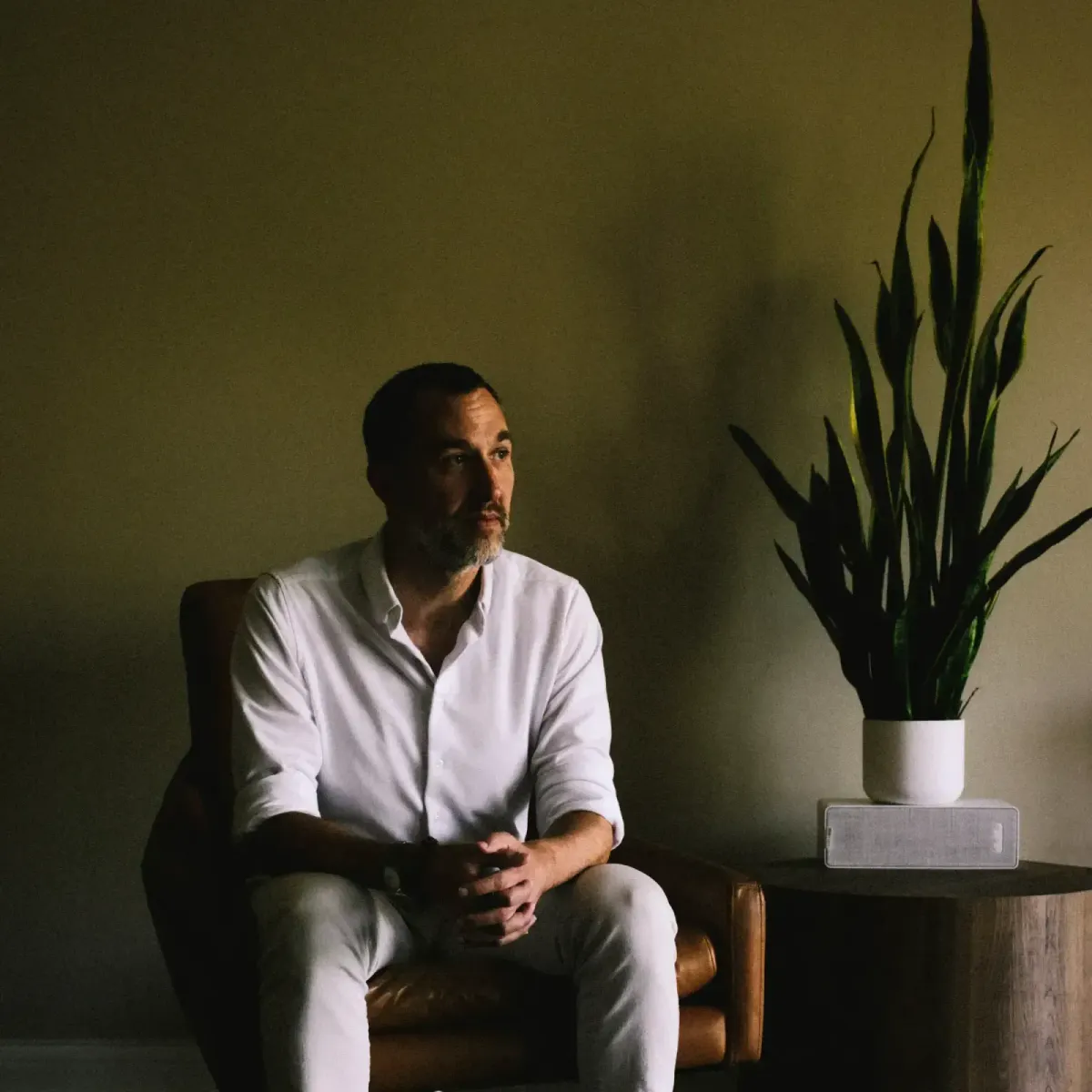
James A. Reeves is a writer and designer in the Middle West who makes midnight mix tapes and writes about faith in the digital age.
He worked in a gas station, was a terrible waiter at an Indian restaurant, ran a record label, was a partner at a design agency, and did a stint in law school before deciding he would rather dedicate his brief time on this planet to making things.
After traveling 50,000 miles along the back roads of America, his first book, The Road to Somewhere: An American Memoir, was published by W. W. Norton. His second book, The Manufactured History of Indianapolis, is a collection of myths about the city. His stories have appeared in Vol. 1 Brooklyn and Heavy Feather Review.
He often collaborates with the artist Candy Chang on installations that introduce new rituals into public space, including After the End, a critic’s pick in The New York Times. Together their work has been exhibited in the Cooper Hewitt Smithsonian Design Museum, the Rubin Museum of Art, the Mint Museum, and Annenberg Space for Photography.
James has taught courses in the history of art and the politics of design at Bard Early College, Pratt Institute, and Parsons School of Design, where he is an assistant professor. He was a 2022 Innovator-in-Residence at the American School in London, and he’s the founder and creative director of Design/Context.
He’s lived and worked in New York City, Helsinki, Philadelphia, Lisbon, New Orleans, London, and Las Vegas before settling in Columbus, Ohio, where he lives down the hall from his in-laws.
Email • Newsletter • Bluesky
Press
“Memorial artworks are notoriously difficult to pull off. Yet Candy Chang and James A. Reeves, two New York artists who have created similar installations in the past, hit just the right tone with After the End, a participatory work in the Historic Chapel at Green-Wood Cemetery.”
THE NEW YORK TIMES
“The inspiration is so simple: Head out at random into America and see what you find. James A. Reeves found the America no one seems to be looking for anymore, and he also found himself.”
ROGER EBERT
“Through his photographs and candid, episodic storytelling, Reeves documents his experiences and the people he encounters in various regions of the United States, reflecting with uncommon honesty on both positive and negative aspects of the culture. Reeves’s obsession with driving long distances in rental cars is fueled by his search to figure out what it means to be an adult and to live a meaningful life in a complicated world."
PHOTOLIFE
“A tantalizing 21st-century cross between James Agee’s Let Us Now Praise Famous Men and Jack Kerouac’s On the Road, this remarkable and utterly original memoir heralds the arrival of a new and important American voice. James A. Reeves’s The Road to Somewhere will take you places you will not easily forget.”
ANDRE DUBUS III
Exhibitions
- The Nightly News
Broad Museum · East Lansing, MI
The American School · London - After the End
Historic Chapel at Green-Wood Cemetery · Brooklyn - Light the Barricades
Annenberg Space for Photography · Los Angeles
Mint Museum · Charlotte, NC - A Monument for the Anxious and Hopeful
Rubin Museum of Art · New York - Grief is a Beast That Will Never Be Tamed
Lakkos Project · Heraklion, Greece - The Atlas of Tomorrow
Mural Arts · Philadelphia
Cooper Hewitt Smithsonian Design Museum · New York
Books
- The Road to Somewhere: An American Memoir
W.W. Norton - The Manufactured History of Indianapolis
We Are City / IUPUI
Residencies
- American School of London
Innovator in Residence - Archipelago Art Residency
Korpo, Finland - Hemera Foundation: Tending Space Fellowship
Garrison, NY - Hangar Residency
Lisbon, Portugal - NES Residency
Skagastrond, Iceland - The Lakkos Residency
Heraklion, Greece
Current Clients
- 3BL
Creative direction, design, and web development - Lowell Institute
Creative direction, design, web development - TriplePundit
Creative direction, design, web development - Cambridge Forum
Creative direction, design, web development - Consortium for Sustainable Urbanization
Creative direction, design, web development - C. Wall Architecture
Design and web development - Town of Atlantic Beach, North Carolina
Creative direction, design, web development
Colophon
Built with a custom Ghost theme that I’m forever tuning. The current typography is Bebas Neue Pro and IBM Plex. Much of my thinking on typesetting comes from Butterick’s Practical Typography.
The Midnight Radio mixes are produced with a seven-year-old version of Ableton Live, lots of reverb, cassette loops made on a Boss RC 30 pedal, and occasional field recordings of taiko drums and philosophical friends.