James A. Reeves

Notebook

Light
Uspenski Cathedral, Helsinki

Light

Note to self: You will never remember to write it down later. And so this journal continues. Today I started reading Italo Calvino’s Six Memos for the Next Millennium, a series of lectures written just before he died in 1985. In his essay on the quality of lightness, he describes the challenge of writing about the present:

Full of good intentions, I tried to identify myself with the ruthless energies propelling the events of our century, both collective and individual. I tried to find some harmony between the adventurous, picaresque inner rhythm that prompted me to write and the frantic spectacle of the world, sometimes dramatic and sometimes grotesque. Soon I became aware that between the facts of life that should have been my raw materials and the quick light touch I wanted for my writing, there was a gulf that cost me increasing effort to cross.

It is too easy to let the world’s heaviness infect our writing, says Calvino. Adjectives for pain and suffering are endlessly rich and vivid. This brings to mind a line from Arthur Schopenhauer, the master of pessimism: “For whence did Dante take the materials of his hell but from our actual world? And yet he made a very proper hell out of it.”

And there is so much rich material these days. Pandemics, drones, climate change, tribalism, billionaires, electric scooters, and words like ‘retweet’. Anxiety spreads from screen to screen like a virus, thriving on the rage mechanics of social media. But where do we turn for light? Schopenhauer again: “But when, on the other hand, Dante came to describe heaven and its delights, he had an insurmountable difficulty before him, for our world affords no materials at all for this ”

Finding lightness becomes the job. And if it cannot be found, it must be invented. But it must be earned, or else it’s nothing more than the optimism of the delusional or the saccharine nonsense of a charlatan. Maybe these days of flux are preparing us to clear the stage for a better show. I do not want my writing to become so fixated on our modern unease that it reads like a compulsive inventory of the dark alleys of the psyche with little interest in seeking out any kind of light.

I’ve eaten at the same burrito place three days in a row.


Tim Hecker – In The Fog II

From Ravedeath, 1972 | Kranky, 2011 | Bandcamp

Tim Hecker’s Ravedeath 1972 provides the soundtrack for Calvino’s lightness. Recorded in a church in Reykjavík, the shudder and drone of a pipe organ is frayed by technology, shredded by filters, and buried beneath reverberated clouds—until the occasional clear note comes down, crisp as sunlight and sounding like grace.

Glitch
Ducks in a row, Central Park

Glitch

This morning I went jogging for the first time in months because I signed up to run a half-marathon in May for reasons that remain unclear to me. After a mile or so, I was doubled over by the reservoir in Central Park, cursing the forces of entropy. Then I saw something that took away the little breath that remained: a row of ducks bisected the pond in a ruler-straight line that stretched from the pumphouse on the north shore to the one on the south. The mathematical precision of these birds looked improbable. Maybe it was a harbinger of cosmic change, a hidden pattern made visible. Or an unprecedented glitch in the fabric of the world. The answer is likely more prosaic, but I’d rather not know the reason.

The death toll for the coronavirus crossed 100 today and the newspapers advertised the number like a score. More bombshell revelations about presidential corruption, although they will soon be forgotten by the time a handful of senators have chummed the waters. What has happened to these sad old men to so completely deform their sense of reality? They scowl and encourage us to deny our senses, breathing fresh life into Orwell: “The party told you to reject the evidence of your eyes and ears. It was their final, most essential command.” No, you did not see the president do that. No, you did not hear him say that. Facts are elastic, truth is relative, and we’re living in a frightening version of Moore’s Paradox: “It’s raining but I don’t believe it is raining.”

Hidden
Late night train, NYC

Hidden

I’m struggling to return to the rhythm of New York after spending a month on a dark island in the Baltic Sea. But the muscle memory of the subway always remains: its iron shriek and crowd compression, the buskers in red tracksuits twirling their hats to an overdriven breakbeat before wishing everybody a blessed day. And the surreal sight of all of us sitting in a row, staring into little pieces of glass.

I opened my increasingly tattered copy of Seeing Is Forgetting the Name of the Thing One Sees and returned to the artist Robert Irwin’s monastic obsession with lines, dots, and discs. Just as I was about to give up on his fixation with flatness and picture planes, he described his desire “to dig into the root question of how an orthodoxy becomes so deeply rooted that becomes hidden.” I closed the book and watched everyone on the subway swiping and scrolling, hunting for something. Or escaping. I felt my own hands twitching, inching towards my telephone in search of fresh data and virtual interactions. How did these cravings and gestures become so ingrained so quickly?

Airlines are limiting flights to China as the spread of the coronavirus continues. Billionaire candidates are buying better poll numbers while a death cult in the Senate defends the current president’s crimes. Democracy feels like it’s circling the drain. There still isn’t any snow. These are uneasy days of sensing that the world has been altered in some fundamental way, that the sooner or later the piper must be paid and we will need to change our ways. And maybe we will. Maybe our orthodoxies are becoming less hidden now that so much deeply weird behavior is on display. Last night I had a dream about something called digital atonement.

Rotation
New York City

Rotation

The volume is louder in America. Voices and sirens, the televisions playing in empty lobbies and waiting rooms. We talked about not staying in New York. We talked about finding a way back to Helsinki and we discussed moving to Taipei. We imagined ourselves in the Mojave desert. I paced. I flipped open a book. My eye landed on Kierkegaard’s “rotation method” in which he compares the shape of a life to the rotation of crops in a field:

One tires of living in the country, and moves to the city; one tires of one’s native land and travels abroad; one tires of Europe, and goes to America, and so on; finally one indulges in a sentimental hope of endless journeyings from star to star. Or the movement is different but still extensive. One tires of porcelain dishes and eats on silver; one tires of silver and turns to gold; one burns half of Rome to get an idea of the burning of Troy. But this method defeats itself: it is plain endlessness.

Instead of changing the location, Kierkegaard argues, we must change the method of cultivation. “Here we have the principle of limitation, the only saving principle in the world,” he says. “The more you limit yourself, the more fertile you become in invention. A prisoner in solitary confinement for life becomes very inventive, and a simple spider may furnish him with much entertainment.”

Today a basketball star and his daughter were killed in a helicopter crash in Calabasas. Breaking news that the former national security advisor with a ridiculous mustache wrote a memoir about the president’s illegal behavior. He probably won’t testify in the impeachment trial but his book will be a bestseller when it comes out next month. A decade ago nearly sixty inches of snow had fallen in New York City by this point in the winter. As of today, there’s barely been four inches this season.

Further reading: Søren Kierkegaard; excerpt from Either/Or (1843) via Lawrence Weschler’s Seeing Is Forgetting the Name of the Thing One Sees.

Turbulence
Amsterdam to New York

Turbulence

The turbulence began the moment we entered American airspace, crossing from New Brunswick into Maine. The airplane shuddered and rocked. We fastened our seatbelts. It was hard not to read this as an omen.

I find myself searching for cosmic meaning whenever I’m on a turbulent airplane. I’m filled with a sudden belief in fate, full-bodied vibrations of doom, and a craving for god. Then the air grows calm and I return to gazing into a screen.

Slow-motion guitars that sound like they’re holding the world together even when everything feels like it’s falling apart.

A Robot Scanned the Fading Canvas of a Rembrandt
The Rijksmuseum, Amsterdam

A Robot Scanned the Fading Canvas of a Rembrandt

At the Rijksmuseum, a crowd gathered in front of a plexiglass box to photograph a robot scanning the fading canvas of a Rembrandt. A glimpse of the future. Looking at the tiny figures chatting and fishing in the shadows of moss-covered arches in Claude Lorrain’s Harbor at Sunrise from 1637, I realize it’s a genre as old as time, these wistful scenes of people living among the ruins of a romanticized past. There’s a straight line from the paintings of Lorrain and Hubert Robert to the set design of Blade Runner 2049.

Meanwhile, the debate continues across six centuries of oil painting: did Jesus die as a man or a god? The image of the crucifixion did not emerge until a thousand years after his death. People sweep through the galleries, looking at the paintings only through the screens of their phones. Taking pictures is how we see now.

Everything is garbled. I think about ways to meld the personal, historical, and philosophical with each day’s disorienting headlines and events. Can this exercise be shaped into something worthwhile? Because this is how we think and live these days: everything at once. Maybe we have reached the end of grand statements, singular works, and distinct styles. The tides are turning towards snippets of atmosphere, personality, and mood. (I’m rediscovering the obvious and reinventing postmodernism for myself.)

Fog in Amsterdam. Jittery energy in the Friday night streets. People from different nations stagger and bump into things. It’s an uneasy convergence of Bourbon Street and Times Square with picturesque European architecture. We found the electric red Chinese restaurant where we started this trip forty days ago. Over fried dumplings we talked about returning to America while our telephones buzzed with footage of the House prosecutor delivering his impassioned closing remarks to the Senate, urging them to acknowledge the evidence in plain sight: “If you find him guilty, you must find that he should be removed. Because right matters. Because right matters and the truth matters. Otherwise, we are lost.”

Bohren & Der Club of Gore – Sag Mir, Wie Lang

From Patchouli Blue | Ipecac Recordings, 2020 | Boomkat

A new album from Bohren & Der Club of Gore arrived today and it’s the perfect soundtrack for these days of pandemic anxiety and political sleaze.

Maybe religion and weather are intertwined.
Goodbye, Helsinki

Maybe religion and weather are intertwined.

One last train through the Helsinki gloom. I will miss this city’s dignified buildings and straightforward sensibility. What shapes the personality of a place? Perhaps cold weather yields orderly queues and quiet sidewalks rather than the chaotic crowds and ad hoc markets that fill the streets of warmer cities. Or is religion responsible? The spartan Protestant ethic of northern Europe versus Catholicism’s pageantry, local saints, and elaborate methods for hacking damnation through confession and Hail Marys. Maybe religion and weather are intertwined.

Night flight to Amsterdam to visit the Rijksmuseum and the Stedelijk. I’m burning up my savings to look at art. I prefer flying at night, cocooned in a netherworld beyond space and time, no longer aware of hovering above the earth at thirty-thousand feet.

Meanwhile, China has quarantined a city of eleven million people with more cities to follow. Two cases of the coronavirus have been confirmed in the USA, one in Washington and another in Boston. Maybe a student in Texas. America’s irrational droning of an Iranian general seems to have been forgotten, along with the passenger flight from Tehran to Kiev that was accidentally shot down by Iran’s army, killing 176 people. The news cycle lurches from one catastrophe to the next, and this decade is racing out of the gate with impeachment, drone warfare, and pandemics.

A woman on the plane has a coughing fit and we all turn to judge the poor passenger, evaluating the risk.

January 22, 2020
Midnight in Helsinki

January 22, 2020

I’m starting this new decade—and this journal—by revisiting the places where the last one began. Strange how a chunk of time takes shape in the mind, those first arbitrary encounters that define a sense of a place or tint a season. When Candy and I arrived in Helsinki ten years ago, deep snow covered the city. We checked into a hotel in an industrial area by the sea, and I remember smoking a cigarette in the subzero wind while watching the lights of freighters on the horizon. I thought we were at the edge of the earth. I remember the two of us navigating the icy cobblestones of an unfamiliar country, hunting for someplace to eat. We found an empty restaurant that was still open, a rustic place with a buffet of reindeer, herring, and mushrooms. A sign on the window said Ravintola.

When we told people we enjoyed eating at Ravintola, they gave us puzzled looks. A few days later, we worked up the courage to figure out the public transit system. As we rode the tram across the city, we saw the word Ravintola again and again. We saw it painted on windows. We saw it on billboards. We saw it in neon lights. Oh they have so many locations, we thought. And wow, they also serve Chinese. Then came that uniquely vivid realization of being an idiot: Ravintola is the Finnish word for restaurant. We’d told people we enjoyed eating at restaurant.

As the years passed, our wintry meal at Ravintola became burnished into the stories we told about our year in Helsinki. Returning ten years later, we wanted to see if it still squared with our memories of a warm refuge from the storm with a kindly old proprietor cooking traditional food. When we found the restaurant, it was smaller than we’d remembered, as most things are when you return. And it wasn’t sitting alone in a snowfield like an oasis. It was in the middle of a nondescript block of shops and there wasn’t any snow this January because we live in a new climate now. Our waiter was a hip young man with tattoos. French and German tourists filled the tables. But the reindeer was still there and so were we.

Springwater – I Will Return

Polydor, 1971 | More info
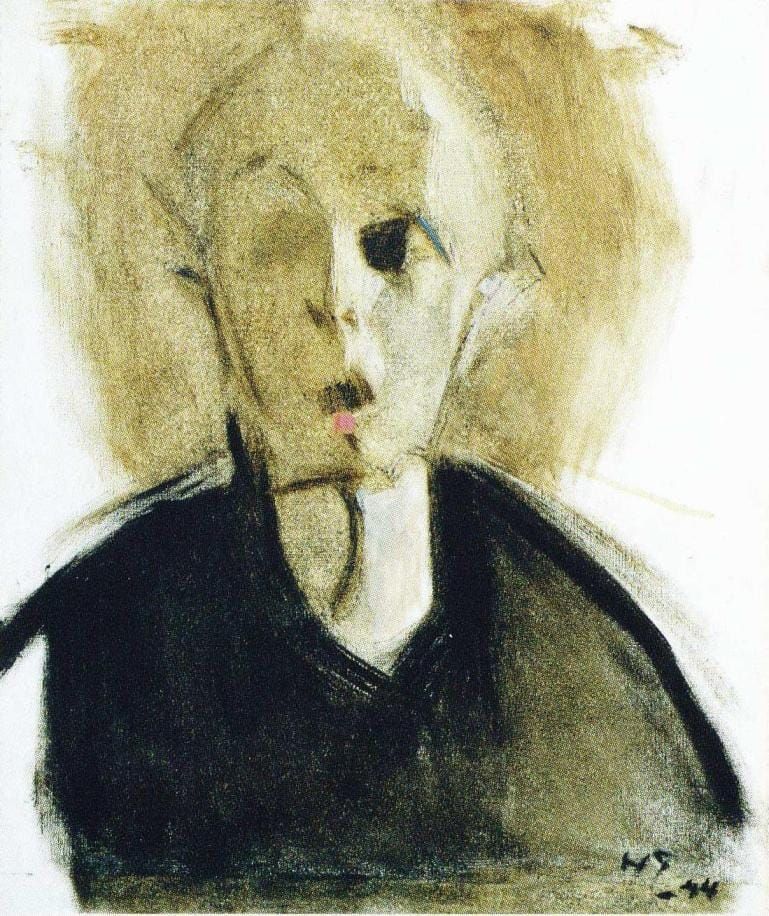
Helene Schjerfbeck’s self-portraits

Helene Schjerfbeck’s self-portraits

I was shaken by Schjerfbeck’s self-portraits at the Finnish National Gallery. Taken as a series, these paintings grapple with mortality and disappearance. Perhaps a self-portrait always does. But these do not flinch. In the last two years of her life, Schjerfbeck painted twenty pictures of herself until she begins to appear alien. The final image comes just before her death at the age of 83: a simple charcoal sketch of her face, half illuminated and half in shadow.

Our art and literature are fueled by the desire to capture and archive the self, to untangle the mess of dealing with being a person who knows they will disappear someday. Can a series of Instagram snapshots be viewed as an extension of Schjerfbeck’s inquiry? Today’s social media inherently coats any image with the gloss of performance rather than something earnest, curious, and raw. But perhaps the screen itself has become too tainted by the nervy energy of distraction and need to allow for contemplation.

Past
The corner of Uudenmaankatu and Mannerheimintie

Past

I spent the day returning to scenes from a decade ago, starting with the place I once lived: 33 Uudenmaankatu in the neighborhood of Punavuori. The secondhand bookshop is still on the corner, and the Thai spot with the good tom kha soup is still next door. This street feels frozen in time, much like the city’s stern buildings that remind me of battleships. Whenever I come across Goethe’s maxim that architecture is frozen music, I see Helsinki.

I rewind the events and decisions that took me away from this city. The sudden death of my mother. Returning to Detroit and then New York and then New Orleans. If my mom were still alive, would I know how to roll my R’s and speak passable Finnish? Would I be more sensible if I hadn’t spent the past decade living in America’s sturm und drang? I do not want to become a man who relitigates the past. This is why some of us meditate, and others drink. Doing whatever it takes to stay in the present moment. Strange that this is so hard.

The Caretaker – It’s Just a Burning Memory

From Everywhere at the End of Time | History Always Favours the Winners, 2016 | Bandcamp

A dusty record plays in the other room. Sampling old 78s that decay with each subsequent recording, Leyland Kirby maps the borderlands between nostalgia and despair. Dust motes suspended in sunlight. Old men in libraries. Hushed ballrooms where time has disappeared. It’s the sound of memories blurring before falling apart.

The Wonder Is Still There
Kotiharjun Sauna, Helsinki

The Wonder Is Still There

Looking at the sky tonight, I think about Origen of Alexandria, the philosopher who believed the stars were rational creatures and the sun could sing. Maybe we’ve lost something over the past two thousand years, some critical capacity for wonder.

I’ve started reading Seeing Is Forgetting the Name of the Thing One Sees, Lawrence Weschler’s collection of interviews with the artist Robert Irwin. “The wonder is still there,” Irwin says again and again.

In the sauna I chat with a wrinkly man about the unusual weather. “Still no snow,” he says. “Still a black winter.” He douses the rocks and we listen to the steam. At one o’clock in the morning, I visit the döner kebab stand in front of the train station. I talk with a Sioux from South Dakota and a Finn who logged some heavy time in Vegas. Cities are such fantastic inventions. The wonder is still here.

Further reading: Origen of Alexandria, black winter, Robert Irwin, and Seeing Is Forgetting the Name of the Thing One Sees.

January 18, 2020
Helsinki Central Railway Station

January 18, 2020

Alone in Helsinki. The sky is pure gloom with rain that hangs in the air, refusing to fall. It’s the weather of moody seaside walks with headphones and an upturned jacket collar. I do not understand the Nordic tradition of standing at an empty intersection, waiting for the light to change, even though there is not a car in sight. It spooks me, this devotion to a traffic signal rather than our own eyes and ears. I wander through Helsinki’s elaborate network of shopping malls, admiring the garbled Americana: Restaurants named Vegas and Bronx. A poster with Marilyn Monroe in front of a cactus.

Walking to the bookstore, I’m startled by the muscle memory I’ve retained from this city where I lived a decade ago. I pause on the corner of Aleksaterinkatu and Mannerheimentie, overwhelmed by memory and possibility. I can’t tell if I miss the city itself, the people I knew here, or that the last year in my life before I lost my mom and the world still felt big and certain. Regardless of the reason, Helsinki is one of my favorite cities, and I fantasize about living here again someday. Near the train station, I overhear an old man with a beautiful white beard say, “The situation is that we’re born, then we die, and what the fuck.”

NǽnøĉÿbbŒrğ VbëřřĦōlökäävsŦ
Journey Through The Hercules-Corona Borealis Great Wall

From Goodbye, Sol: A Voyage To The End Of Spacetime And Back | 2014 | Download

Also known as Nanocyborg Uberholocaust, this project is an “ambient cosmic extreme funeral drone doom metal band” that claims to be a collaboration between two scientists at a research center in Antarctica. Their tracks are long spiraling exercises in slow-motion reverberations with moments that sound like devotional music for the future. Many thanks to Adam Greenfield for introducing me to this. It’s been the perfect score for reminiscing in the streets of Helsinki. Their catalogue is freely available here.

1 / 1